Practical Resources & Inspiration
For Women Who Travel (or Want to!)

Advice for Women Travelers: Health
& Safety






See see my
reviews of hotels & other travel services on Trip Advisor.
Advice
Don't let concerns about personal safety keep you from traveling
altogether - except during something like a global pandemic, or after an extreme
disaster when local systems are taxed.
Yes, many thieves and otherwise bad people target travelers
specifically, and target women specifically. But these same kind
of people also target locals who are Christmas shopping in their
own communities. Yes, global pandemics happen, and you may need to
delay your long distance travel, for your safety as well as out of
respect for the safety of others, but
there are ways to do road trips and overnight stays in
contact-free, socially-distanced, safe way in your own country in
such times.
I have a British friend who went to Morocco and she never felt
unsafe or particularly harassed, unlike when she visited St.
Louis, Missouri, USA a year before, when a hotel employee tried to
break into her hotel room in the night. I have another
well-traveled friend who went to Morocco and was harassed and felt
in danger the entire time. I have American friends who went all
around the world for a year with their children, and never had a
problem until they were back in the USA and had things taken out
of their luggage at a DC airport.
Dangerous and/or opportunistic people, as well as wonderful
people, are everywhere. That hasn't stopped me, or
millions of other people, from traveling - or walking out the
front door. The only thing that's stopped me from traveling has
been lack of funds or the global pandemic (I stopped traveling
before I was vaccinated both for my safety and out of respect for others). But, absolutely,
women need to take extra precautions, whether solo travelers or in
groups.
I'm also very conscious that I'm a white woman and, therefore, I
don't face the level of or same kinds of security concerns that
black Americans face when traveling, whether in the USA or abroad,
or any other race perceived as different from me, for that matter.
I am reminded of this when I read an article like this one offering thoughts from three
different hikers in the USA or this one about traveling abroad or various
links from the Outdoor Afro Facebook page or when I talk to
my many colleagues and friends from Africa - most especially the
female friends. I am reminded of this when, in Jordan, and a woman
from Central America asked to hike with my husband and I in Petra
because she was so tired of being constantly sexually harassed. So
I want to acknowledge my privilege - that privilege is throughout
my travel advice, and I acknowledge that.
I'm also conscious that a global pandemic completely derailed the
travel of millions of people. It stranded people abroad, like Jeremy
Kroeker and Elle West, on an epic motorcycle journey from
Canada all the way to the Southern tip of South America and back -
stuck in Uruguay for months. Check
out this blog where I note several people
stranded abroad because of the coronavirus pandemic and the
lessons learned from travelers stranded because of COVID19 (we were in Mexico when numbers started
surging). And I am appalled at how privileged people acted
during the pandemic, with unvaccinated motorcycle travelers in the
USA happily driving over the border with Mexico as though they
weren't putting other people in danger, nor worried about further
contributing to the image of USA travelers being inconsiderate
assholes.
This part of my travel advice is the
hardest to write, because while I want to be realistic, I also
DON'T want to
- scare the bejesus out of women, who become so frightened by me
they chose not to travel.
- sound like I'm blaming theft or assault victims for what
happened to them (women are NOT raped because they trusted
someone or thought they were safe in a particular place - they
are raped because someone targeted them for such, and that is
not always something you can have control over).
- imply that these tips are guaranteed ways of staying safe.
I also cringe at the idea of saying to a woman, "You can't go out
for drinks, you can't ever be alone with a stranger, you can't go
on a guided tour by yourself, you can't ever dress such that you
feel beautiful, and you can't stay out late, because you're a
woman, and you might get raped!" Travel safety shouldn't mean
feeling ever-restricted or continually afraid or never taking
risks or never ever trusting strangers. But travel safety does
mean thinking about surroundings, learning about a location's
culture and crime rates, thinking about the chances that
circumstances can change, thinking about why you are trusting
someone - and then balancing all of those considerations with what
it is you want to do and making what you think is the best choice.
Travel safety advice for women is about staying aware of
your surroundings and assessing the risks of various situations
you will encounter while traveling - often more so than if you
were a man, I'm sorry to say, because women are often targeted
specifically because of their gender and a perception that they
are weak - no matter what their age or appearance. It's about
realizing things like how you actually might be MORE safe with
local men than someone from your own country you met on the road,
or that all those people who blogged and said, I traveled to
such-and-such place, and did such-and-such thing, I was fine,
therefore, all safety warnings are alarmist and untrue were
just lucky, and you might not be.
Remember: women who are harmed while traveling tend not to blog
about it or make YouTube videos about it.
It's so unfair: I doubt any man has a plan for what he's going to
do if he's raped while traveling.
With all that said, here's the good news: learning to be more
aware of your surroundings and avoiding certain risks while
traveling will help you be safer in your every day at-home
life.
Also see: Lessons learned from travelers stranded because
of COVID19.
- I have advice on preventing motion sickness in the section of
this web site regarding transportation
and accommodations choices.
- Call your health insurance provider and see how your
insurance works if you are away from your primary care provider
and doctors in your network in your own country or abroad,
depending on your destinations. Always ask if they will cover
you for travel abroad, if you are leaving your country. You can
get temporary travel health insurance (check the Lonely Planet and Rough Guide web sites for
more information and special deals, as well as AAA if you are a
member) - I highly recommend you do this even if your health
insurance company says they will cover you abroad. If you are
going to be driving or riding a motorcycle, check with your
insurance provider for such about coverage, for both accidents
and health-related stuff (when I had a medical emergency in
Utah, it was my motorcycle insurance, not my health insurance,
that covered the costs).
- There is very affordable insurance that will pay to transport
you back to your home across the country or back to your home
country in an emergency health situation - or to transport your
remains. Hope I never need them, but I use World Nomads.
- If you are traveling outside the USA, buy supplemental health
insurance. The US Department of State has an excellent web site
on Medical
Information for Americans Abroad. In addition, consider
buying Medical
Evacuation Insurance if you are traveling abroad. The US Travel Insurance Association
(UStiA) is a national association of insurance carriers,
third-party administrators, insurance agencies and related
businesses involved in the development, administration and
marketing of travel insurance and travel assistance products.
Again, I use World Nomads.
- Take all the medications you think you might need but might
not be able to buy whenever needed, and if you have prescription
medication, make sure the bottle descriptions are such that the
medication could not possibly be confused for illegal narcotics.
If you are going to a country where English is not the primary
language, consider carrying a list of your medications and what
each is for. Carrying them in their original containers is
always best for dealing with law enforcement.
- If you are going to a country where English is not the
primary language, have written down what the phrases are for
conditions such as "I have a yeast infection" or "I have a
urinary tract infection" or "I am having an allergic reaction to
a bug bite" or "I have an allergy to peanuts and if I eat even a
tiny portion of them, I will die" or any other medical
conditions you get somewhat regularly or are most worried
about.
- Take two or three washable face masks that fit SNUGLY across
your nose and under your chin, such that, if you were to sneeze,
it would hold most of what you expel. Masks protect others from
you more than it protects you from others, but it IS protection
for you, and you never know when a virus will break out and
masks might be mandated. A bandana or a neck gaiter is NOT
enough! Wearing the mask over your bandana or neck gaiter is
awesome protection. Note: wearing a mask is both to keep you
safe and to show respect.
- Wash your hands at every opportunity, up to your wrists. It's
fine to use a shared bar of soap - soap is filled with
detergent, and detergent kills viruses better than almost
everything. Also take a small bottle of hand sanitizing gel
(remember your liquid limits on planes) to use when soap and
water isn't available. Be vigilant about washing / sanitizing
your hands!
- Waterborne illnesses are horrific. Individual-use bottles of
water are horrible for the environment - but the reality is
that, in some countries, you need to drink bottled water, brush
your teeth with it, etc. In Mexico, India and many other
countries, hotels have a big bottle of water in every hallway -
carry an empty plastic water bottle or two and fill them up, and
use such for drinking and brushing your teeth.
Getting Help for Health Issues
Too many travelers think that if they are generally healthy, or
have never been sick while traveling, they won't face this dire
situation. Trust me: it can happen to anyone.
This is a post to a Facebook group I follow, for foreigners that
are traveling by motorcycle in Mexico, or want to. What if this
was you traveling abroad?
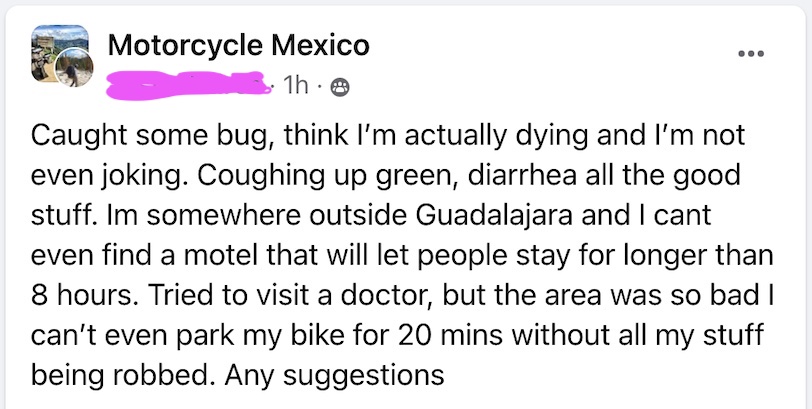
Caught some bug, think I'm actually
dying and I'm not even joking. Coughing up green, diarrhea all
the good stuff. I'm somewhere outside Guadalajara and I can't
even find a motel that will let people stay for longer than 8
hours. Tried to visit a doctor, but the area was so bad I
can't even park my bike for 20 minutes without all my stuff
being robbed. Any suggestions.
It's a scary situation, even if you are in your own country!
In your own country, I'm going to assume you know how the health
care system works and how to get medical help and how to find
accommodations if this happens to you while you are traveling. If
you are staying at a hotel or motel, ask the front desk if there
is a hospital or clinic nearby if you can't find one on your phone
or laptop and the Internet, where the nearest pharmacy is, etc.
And let the staff know you are very ill - they may look
out for you, make sure you haven't passed out or died, etc.
If you are traveling abroad outside of your own country and are
in the USA or other developed countries - Canada, somewhere in
Europe, Japan, etc. - you should be able to find an emergency
medical facility that will help you, via an Internet search or a
referral. Just know that, in the USA, you are going to pay a LOT
for treatment, and waiting times can be horrible, both because of
COVID and because of how our health care system "works." If a
hospital or clinic can't help you, ask them where the nearest one
is that might be able to help you.
In many countries, pharmacies can give you medicines without a
prescription that would require such in the USA.
It's essential when you are abroad that you carry a smart
phone with a local SIM card and Internet access so that you can
search the Web for information about clinics and accommodations
in case of emergency.
Check the web site of your country's consulate in the country you
are in - they MAY have information about English-speaking clinics
on their web site.
Whatever you do, do NOT let an illness get to the point that this
person is experiencing before you seek medical attention, if at
all possible. And do not wait for such a dire situation to get
local Internet access on your phone.
My suggestion regarding the motorcycle dilemma would be to do
just what this person did: post to an online group known for
travelers helping travelers and say exactly where you are and how
to contact you (his post included a map showing EXACTLY where he
was). Don't wait to find such a group before you go - already be a
part of the group before departure. Or, make sure your network is
following you on social media while you travel so that, if you
need their help, you can let them know. The of this guy posting to
an online community known for travelers helping each other:
- Someone back in the states called at least 20 hotels to find
one with that had secure parking, and was able to negotiate with
the one she found so that the rider could stay two nights
instead of just one.
- Someone else suggested finding and paying a garage or a
shopkeeper or even someone at a church to watch the bike while
the rider saw a doctor (pay something upfront and tell them you
will pay them again when you're back).
- Group members found a reputable hospital that had
English-speaking staff 40 miles away, but the rider couldn't
make it without some temporary treatment, and another user was
able to find a local clinic - he provided the contact info and
added, "If you don’t speak Spanish and he doesn’t speak English
you can call me and I will translate..."
- nd this also response came in: "I have a Airbnb not too far
from you are ! I will help you out and give you especial Rate!
If you want me to pick you up I will ! Take you to the doctors
near by !! I have secure place for your bike ! Call me... I have
a Trailer with a pick up truck let me know!!"
General Safety for Women Travelers
- Take a self-defense class before you travel. Take more than
one. Learn how to get out of a choke hold, learn where to hit or
poke someone where it counts, and practice those moves. These
classes are very empowering and will help you in your every-day
life, not just while traveling.
- Always be aware of the people around you. Know who is behind
you and beside you, on public transport, in a restaurant, in the
lobby of a hotel, at a museum, and on and on. It doesn't have to
be a scary thing - it can actually really enhance your
experience, help you to be all the more present, help you see
things that will delight you, rather than scare you.
- Don't get lost in your smart phone messages - in fact, why
read social media or messages at all when you're traveling in
public and want to experience a new place? Do not walk and talk
on the phone or walk and text. Do not stand on a sidewalk and
talk on a phone or text. Use your smart phone to read messages
or make calls only when you can find a safe space where no one
can walk up behind you or walk up to you and snatch your phone
away or knock you down. If you need to look at a map, including
on your phone, go into a shop to do so.
- If you are going to listen to music, don't read as well,
unless you are on a plane and its safe to do so - that closes
you off way too much from people around you. Reading a book in
public is fine, but you need to regularly look up and around.
- Don't ever be so inebriated that you won't always be WELL
aware of the people around you, where your purse is, etc. More about safety at bars &
pubs later on this page.
- Never let a budget keep you from staying safe. If you feel
that you need to upgrade to a better hotel, or to first class on
a train, in order to feel safe, do it. If you need to take a
taxi to get you out of a bad area of town, do it (but always
book through a company or service - don’t flag a taxi down in
the street, especially if you’re alone).
- When traveling alone, don't be the only woman in a train car.
If you are on a bus, sit with a woman or a group of women or a
family (they will sometimes "adopt" you for the trip - by all
means strike up a conversation with the kids or the women!), or
as near the driver as possible. Do not get in a mini-bus or any
other transportation except a cab (see earlier advice) that does
not have other women traveling.
- Avoid driving or traveling at night. That's not only to keep
you from being victimized; it's also a great way to
substantially reduce your chances of being in a road accident.
Of course, there are exceptions: some places are best enjoyed at
night, or in the wee hours of the morning, before sunrise.
- If you have to wait for a bus or a train alone, either find a
group to stand near, or stand in a well-populated restaurant or
business until it's almost time for the bus or train to arrive,
or stand where a train station worker can see you. NEVER stand
there alone listening to your MP3 player or radio or whatever in
both ears, even in day time.
- Avoid sitting or walking in empty areas (empty train car or
an empty street), no matter what time of day.
- Look at your hotel room when you arrive. Do all the doors and
windows lock? What kind of access is there to your room from
outside (windows, fire escapes, adjoining balconies, etc.)? If
there is a fire, how will you get out? Be on the lookout for
peepholes - these will be in the door and in a wall shared with
a hallway. Cover the TV with a towel - it's a great place to
hide a camera (and, yes, it happens). Consider turning off all
the lights and seeing where any light might be shining in from a
peep hole. If you aren't satisfied, ask for a different room or
leave altogether. It is perfectly acceptable to ask to view a
room before you pay. And once you are in your room to
stay, use all the door locks AND use a door stopper - I actually
carry one with me when I travel: it's a piece of plastic, about
three inches long, in a long triangle shape, and if you stick it
as far as you can into a door, it makes it very, very difficult
to open. Only thing about it: if you need to get out of your
room fast, in a panic, don't forget to reach down and remove it.
- It is so easy to hide a camera in a hotel room or room you
rent from a family, and such cameras are so cheap now, that
there are a LOT of people doing it, even in developing
countries. Here's
how to look for such cameras in your room.
- Go to Google and type died
of carbon monoxide poisoning in a hostel or hotel. Behold
all the stories - from Florida, from Spain, from all over the
world. Or go to carbonmonoxidekills.com.
Learn how to stay safe in your accommodations in cold weather! I
carry a carbon monoxide detector.
- Don't assume men in uniform are automatically safer than men
not in uniform, even in the USA.
- Don't go with the cheapest or nicest male tour guide if you
will be alone or it will just be you and one or two other women.
Get a recommendation from your hotel or a reputable source, make
it clear to whomever you are seeking a referral from that you
want to be safe and you want someone of excellent character, and
make sure your hotel knows you are going with THAT guide that
they recommended and what time you should be back. And make sure
your hotel knows you blog about your experiences, review such on
TripAdvisor, etc. - even if you don't, LIE and say you do. If
that guide steps out of bounds, let the hotel know the person is
crap and that you are going to unleash online that this person
is crap (and call law enforcement if you believe a crime has
been committed, and CHANGE HOTELS).
- In some countries - and this can include the USA - walking in
a crowd means your breasts and ass are going to get grabbed at
least once, or someone is going to rub their pelvis against you.
It's gross, it's humiliating, and if you know "Do not touch me!"
in the local language, by all means, yell it out forcefully. But
then walk right on - the last thing you want is to get encircled
by a group of angry men or boys. Your best bet - avoid crowds
where you will come in body-to-body contact with men.
- Lock your car, lock your door, lock your bags, including your
purse (except when you are checking in at the airport -- they
will break your locks!).
- I keep my wallet in one of two places: when using my
soft-sided briefcase from REI (which is too thick to be razor
bladed open quickly from the bottom), I put my wallet in a
compartment that I can zip, then put a flap over the compartment
that can be fastened twice (so that you can't unzip it without
unfastening and then flipping up the flap), then carry the bag
so that the compartment is facing inward, up against my body.
Or, I put my wallet around my neck and shoulder (the wallet has
a strap) and cover it with a light long sleeve shirt or jacket,
then walk in such a way that I can feel the wallet up against my
side. Either way, I never take this off in public, not even in a
restaurant. I keep a few bills or coins in an easy-to-reach
pocket, for train fare -- if that were to get lifted, it
wouldn't be a huge loss. That means I have to spend a lot of
time to reach my money -- and that further means I need to be in
a safe place before fumbling for such (never on the
street).
- Favorite places to steal purses from travelers are in
restaurants, bars, trains and buses. Do not EVER take your
money, passport, or other vital documents off of your body, no
matter how safe a place looks, even in your own country. Don't
think, "Oh, I'll put it in my suitcase and put the suitcase
under the restaurant table - I'm right next to a wall, no one
can get it." There are countries where children will stealthily
crawl on the ground, unzip your luggage, take your things and be
gone before you ever know it. Or a fight will break out in the
other side of the restaurant and while you are standing up,
looking over, your things are being taken. Also, note a favorite
places to razor-blade purses or pick pockets are trains, buses
and museums.
- In a hold up, thieves don't just take your purse - many want
your coat or jacket too, knowing that's where you have "hidden"
your wallet, and knowing that when you remove your jacket, ta
da, there's your wallet hanging around your neck. If holdups are
a risk in a region where you will travel, consider a money belt.
It's annoying, it's inconvenient, but most hold ups are done as
quickly as possible and thieves just want to grab quickly - your
purse, your luggage, your jacket - and by then, they will
run.
- Do not assume that your fellow travelers are trustworthy
merely because they are also traveling, even if they are on the
same tour group as you, are friends of friends, or they've
seemed fine for the 48 hours you have known them. You are under
no obligation to share a room, a car or a hike with anyone. When
turning down an offer, just say, "I'd prefer not to, if that's
okay." or even "No offense, but that would make me
uncomfortable" or even just "No thanks." If someone gets overtly
offended or starts to pressure you, it's all the more reason to
NOT do whatever it was they were wanting you to do.
- By all means, talk to people -- talk to strangers! -- but
know your boundaries, and don't ever be afraid of being
impolite if you feel uncomfortable in any way. Never be afraid
of being impolite if you feel that someone is stepping over your
boundaries. Do not let ANYONE guilt you into doing something
that makes you feel uncomfortable, whether it's coming into a
shop or sharing a meal or walking down a side street or just
simply talking to them. If someone calls your behavior insulting
because you cut them off or walked away, too bad.
- Negative experiences with men can happen from any
culture or nationality. Never assume someone is okay, or not
okay, simply because of his ethnicity or religion or origins are
the same as yours.
- Just because a person is a Westerner doesn't mean he or she
is any more trustworthy than anyone else.
- Be assertive. Never say "maybe" for buying something, for
sharing a meal, for meeting later, or any other invitation when
what you mean is "no." If you need to cut someone off or walk
away to get the point across, DO IT.
- Parking lots are, to me, more dangerous than most anywhere
else, even in broad day light. Drivers are often more focused on
finding a parking place than looking for pedestrians or other
drivers. And people walking to and from their cars - especially
women - are easy pickin's in airport parking lots, restaurant
parking lots, tourist site parking lots, etc. People getting in
or out of a car, or walking to their car, in any of those
places, are favorite targets of robbers (including right here in
the little town I live in in Oregon). When you park your car,
scan the area. Look around your car. Do the same as you get out
and walk. Do the same as you return to your car, noting if
anyone is standing or walking near the car or near you. Walk in
such a way that other people in the parking lot can see you. If
it's night time, park near the entrance of wherever you are
going, where others can see you getting out of your car. When
returning to your car, carry a flashlight or use your phone
flashlight and use it as you are walking - and don't be shy
about asking restaurant staff to watch you walk to your car.
Load packages or luggage quickly, then get in and
IMMEDIATELY lock the doors. Remember that your car horn and
hazard lights are there for you to use in case of danger.
- Never invite a male who is not a close, trusted, long-time
friend into your hotel room, including hotel employees and food
delivery, no matter what country you are in (including the USA).
If they absolutely need to come in, put away your valuables,
leave the door open, and stand next to the open door, in control
of it, or in the door way, while they do what they need to do
and leave. Most USA hotel employees will completely understand
this behavior. And don't write me and say, "I've NEVER done
this, and I've been FINE!" Good for you. I have talked to two
people who weren't so lucky - and it just takes once with the
wrong person.
- When walking to your room in a hotel, look all around you. If
there is someone close behind you as you approach your door,
consider passing by your door, or turning around suddenly and
walking back the way you came. If you feel threatened, YELL "ARE
YOU FOLLOWING ME?".
- Never walk alone at night unless there will be many other
women walking around as well (and I don't mean sex workers).
- On a train or a bus, if you are with a friend or friends,
even in the USA, all but one of you can sleep -- one of you
needs to stay awake and keep watch and NOT listen to his or her
MP3 player. Sleeping people on trains or the bus, even in the
USA, are super easy targets for thieves. I've known two people
in other countries who woke up on trains to find their wallets
or a bag gone - or in the process of being taken (surprise!),
and have heard of it happening even more to many people. If you
are by yourself -- no sleeping, and no listening to your MP3
player unless you are absolutely certain you aren't going to
miss something you need to hear (the announcement of the next
stop, the sound of someone opening the door or sliding your bag
away, someone begging for help behind you, etc.). On a train in
a developing country, pay extra for an upper berth or first
class if you absolutely must sleep, and be ready hands in the
night reaching up to explore you and the things you have in your
berth with you.
- I'm going to say it again... don't listen to your MP3
player when walking around outside, when you are alone in
a strange building, while on mass transit, while walking on the
street, etc. Even in the USA, I listen to music only on long
rides where I don't need to hear anything (like the stops) and
the passengers around me aren't going to change much during the
ride, or where I feel like I've taken appropriate precautions
against pickpockets. Listening to what's around me is not only
something that helps keep me safe, it's also one of the most fun
parts of traveling.
- Even on a plane, you are vulnerable. People DO steal from
other passengers on planes. And women have been sexually
assaulted on planes. Don't assume the person next to you isn't
going to go through your bag under the seat in front of you
while you are in the bathroom. And don't assume the guy who
brushes your bum or breast did it by accident. Do not hesitate,
ever, from yelling loudly "Stop touching me!" and calling
attendants on a plane.
- Have a plan for worst case scenarios. If you are robbed of
all of your money, what are you going to do? If you are
assaulted, what are you going to do? Think and plan now for the
exact things you will do in the case of something you don't want
to think about - because if it happens, you are going to not be
in a position to try to figure out what to do.
Women's Safety While Tent Camping
There are plenty of places online that talk about staying safe
while camping in regards to bear safety, flood safety, insect
bites, first aid, etc. But what about safety specifically with
regards to being a woman?
There is a perception that camping in a remote area makes you
more vulnerable to crime than staying in a hotel. I disagree. If
no one knows you are in a remote area, and it's not likely
you are going to be found, you aren't going to be targeted as a
crime victim in a remote area.
Are you, as a woman, more or less vulnerable to robbery - or
worse - while camping than while staying in a hotel? I
don't think so. I cannot find statistics anywhere on the matter.
Using Google I can find far, far more stories of women being
assaulted and/or robbed within hotel grounds - even within their
own rooms - than while tent camping.
Each year, I go to Google and type in robbed while camping
(no quotes), and the stories that come up are pretty scary - but
many years apart, and never for the same area (often not in the
same country), so relatively speaking, it seems to be rare. Same
for searches of raped while camping and raped camp
ground : they bring up scary stories but, again, all months
or years apart and in different countries - it's a very rare
occurrence. The cases of strangers assaulting campers that you
will find if you search the same terms: a German couple raped in
2018 in the Siegaue Nature Reserve, north of Bonn, where I used to
live. In 2017, a Russian/British motorcycle rider traveling on her
motorcycle from South America to Alaska was attacked at her
campsite in Boliva, raped and beaten by three men, robbed and left
for dead. She survived (and her story is very much worth reading). In
2014, in the USA, a woman was raped near Devil’s Den State Park on
Saturday night while camping with her children - the rapist had
helped her get her horse trailer unstuck. A Swiss woman on a
cycling trip with her husband in central India was gang-raped by
local men as the couple camped out in a forest in Madhya Pradesh
state after bicycling from the temple town of Orchha in 2013.
I'm sure there are more incidents that aren't reported, and
certainly many attempts that aren't reported either, but think
about how rare these attacks are. I'm sure people have camped in
all these places and been just fine. The blame lies squarely with
the rapists, not with these campers.
My own experience: I've been way more wary of some of the hotels
I've had to stay in than when I've been tent camping. But I also
haven't really camped entirely alone; I've had my dogs or my husband with me. But
would my husband or my dogs really make a difference if someone really wanted to target me
for a crime? It didn't in three of the four aforementioned cases.
What I do know is that, even with the very few, though horrific,
stories of people being assaulted or robbed while camping, there
are many, many, many more news stories of women being robbed,
assaulted and killed in their own homes or in parking lots
near their homes.
So, with all that in mind, here's some tent camping safety tips
for women:
- When you walk into the bathroom or shower, make sure no one
is following you, and check to see if anyone is in or around the
facility. Could people hear you if you yelled for help in the
shower or bathroom? This is not just a nighttime precaution.
- Sorry to be stereotypical, but I avoid drunk men, young or
old, while camping. I don't talk to them and I camp near other
people if such are present - or choose a different campground
entirely.
- I'm not sure if this is a good strategy, but when I've camped
alone, I've liked to camp (and befriend) couples - gay or
straight, male or female, doesn't matter. I have no idea if that
makes me safer, but it makes me feel safer.
- If camping in a camp ground, choose a camp site that is away
from roads; people who rob or victimize campers want a quick hit
and getaway.
- You are probably safer at a camp site with other campers than
if you are the only person camping at a site - don't camp so far
away from other campers that they couldn't hear you yell for
help. If you come to a remote camp site and the only other
campers are one group of men, move on - they may be the nicest
folks ever, but there's just no way for you to know for sure. If
you will be the only person in a camp site - one without even a
camp host - you might want to reconsider camping there at all;
camping rough, completely
hidden from all road and foot traffic, might be a better
option (and if you camp rough, make sure no one could see you by
passing by on a road or trail).
- Inside the tent, don't put clothes or items up against the
side of your tent, where it would be easy for someone to slash
the sides of your tent and make a quick grab; by the time you
wake up, the perp has jumped in a car and is driving away. It
rarely happens - it's never happened to me, and I've never known
anyone personally that it's happened to - but it does happen, as
a search of Google will tell you.
- Keep valuables on your person, even when you go to the
bathroom. Other campers aren't automatically trust worthy just
because they are camping.
The quietest camping night I ever had when a camp ground was
full was in a very run down camp site in Northern England, near
the Scottish border, populated mostly by
Travelers in beaten down RVs. My husband and
I were on a motorcycle, and we left everything in our tent or in
locked metal panniers and walked across the street to a bar for
three hours. And everything was still there when we came back that
evening. It was a family campground, and there were plenty of
people around who would hear me if I called for help. By contrast,
I camped with my dogs at Bottomless Lakes State Park outside of
Roswell, New Mexico, which is a
very
nice campground, but I was terrified the entire night because
there were NO other campers there at all that night.
Women's Safety Traveling Abroad
I'll say it again: dangerous and/or opportunistic people, as
well as wonderful people, are everywhere. I have a British friend
who went to Morocco and she never felt unsafe or particularly
harassed, unlike when she visited St. Louis, Missouri, USA a year
before, when a hotel employee tried to break into her hotel room
in the night; yet I have another well-traveled friend who went to
Morocco and was harassed and felt in danger the entire time. I
have American friends who went all around the world for a year
with their children, and never had a problem until they were back
in the USA and had things taken out of their luggage at a DC
airport.
So I don't want to make it sound like developing countries are
crawling with predators. Also, regions within countries vary: one
province can feel safe while another feels dangerous. And no
safety concern about any country has kept me from going there if I
really wanted to.
Women from the USA are capable, independent, and grew up in a
country where, for the MOST part, it is our legal right in our
country to do anything that a man can do and go anywhere that a
man can go. Unfortunately, this is not how it is in many other
countries. Other cultures may see this capable, independent
attitude and lifestyle as "loose" sexually. This opinion is
sometimes created/reinforced by the perception abroad of
television shows and films from the USA. It can feel insulting to
not be yourself, to have to dress a certain way and not look
people directly in the eye - I so get that. But your safety has
got to be paramount when you're traveling abroad, where you may or
may not get help from the police and legal systems.
If you think something weird just happened, it probably did;, so
speak up! Creating a fuss, especially on public transportation or
in any public place, may shame the creep, or creeps, and may even
rally your fellow passengers to your aid. Never hesitate to find a
new spot on the bus, or take a different train/bus/sidewalk/hotel
room altogether, for ANY reason.
But also note that, in some cultures, being a woman may be to
your advantage: you might have access to women's society and
friendship that is denied to men in certain cultures, for example.
You can be super friendly to women and families with children that
you encounter in shops or restaurants and not have to worry about
your actions being misinterpreted. I've had some amazing exchanges
with women my husband could never have. Some men may be especially
protective of you if you are their customer (and particularly if
you are modestly dressed and making an
effort to be respectful of their culture), and that may pay
off in a situation where other men are being threatening or just
creepy.
- Long sleeves, long skirts and long, loose pants are a girl's
best friend abroad, as are big, big scarves - waxes, sarongs or
dupattas. I have more clothing advice on this page regarding packing suggestions and an on my page
of Packing
Advice For First-Time Humanitarians & Aid Workers.
- Know how the phones work in whatever country you are in and
have a sim card or an extra phone so that you can make any local
or international call you may need to at any time.
- In some countries, thieves will collide with your car or
motorcycle with their own car, motorcycle, or scooter and then
either demand money or, while you are checking damage, loot your
vehicle (happened to my in-laws in Barcelona, Spain in 2018, and
I've long heard stories about such in other countries). Some
people will throw a woman or child into the path of your
motorcycle, bicycle, even car, so you will hit that person and
they can then demand money (see Lone Rider by Elspeth Beard for a
harrowing account of this in India - as well as some of the
other safety concerns noted on the page you are reading now).
- Know exactly what documents you are handing to a customs
agent or government official or police officer - you might want
to count the pages of what you are handing over, out loud, or
say the names out loud ("passport, carnet, motorcycle import
document," etc.) before you hand them over. This lets the person
know you know what you are handing over. Then, when they return
the documents, say the name out loud and before you walk away,
make sure you have them all. Be very nice about it, don't
dawdle, just be a perky, attentive tourist as you do this. Why
do this? Because later, when you try to leave the airport or get
just a mile or two from the border, a government official may
ask you for a specific paper and, unbeknown to you, the last
government official you talked to took that document and didn't
give it back, so that you could now be fined - you will be asked
for potentially thousands of dollars in cash.
- When going abroad, leave the revealing or super-tight outfits
at home, unless you are absolutely certain it's the
cultural norm for where you are going. What works in Florida is
inappropriate in Egypt. What works at your enclosed compound
full of Westerners in Egypt won't work out on the street. When
traveling, think carefully about exactly what kind of attention
you want to attract. That is NOT to say that women who dress in
a way that could be called provocative should in any way be
blamed for something awful that happens to them - what's
provocative to one person may be prudish to someone else, and no
woman who is dressing to feel pretty, or even to feel sexy,
should be branded as someone who is "asking for it." Just know
that, if you are going to go shopping or to a club or walk on
the street and you are going to wear something that shows your
nipples or your thong or the tattoo on your butt crack, you
can't act surprised if someone comments on it or be offended at
the attention such attracts in a culture where that isn't the
norm for women.
- Sun glasses are a great way to avoid eye contact. Making eye
contact can be misinterpreted in a myriad of ways in countries
abroad. Get a couple of pair of cheap glasses that you can still
see very well through but that don't allow someone to see where
you are looking. I have trouble seeing in sun glasses, and I
take them off when talking to any woman or when I need to
interact with a shop keeper, a waiter, a hotel manager, etc.
- In developing countries in
particular, when you need to ask for directions on the street,
ask women, couples or old people, or go into a well-populated
shop or restaurant and ask an employee. In France, I look for
people who are obviously immigrants, because they seem to always
be particularly happy to help someone who isn't French (not that
they are anti-French, but that they seem to really understand
your outsider feeling).
- When going hiking in an area where you feel like you might not
be safe because you are on your own, consider hiking near a
group of hikers - or even asking a group to look out for you.
When we were in Jordan, a woman from Bolivia who was staying at
our hotel and was touring the country on her own approached us
and asked if she could hike with us the next day in Petra,
because she was being harassed when she was on her own, and we
were more than happy to have her along (it
actually made the day even more fun).
- I hate to say this, but I really do think, based on
observation and conversations with others, that women who are
blond and red-headed, regardless of their race, have more
trouble in developing countries,
or where the hair color of locals is mostly brown or black. So
think about ways to be inconspicuous despite your hair color
(hats and bandanas are good). Yes, I know there are some of you
out there who have had no problem - good for you - please
respect that others have. In addition, women of African descent
can be subjected to especially intense or increased harassment
from men in countries where there are few people of African
descent, such as countries in Asia and the Middle East - a
friend from Kenya told me some of the things men had said to her
out of the blue while traveling - shop keepers, travel agents,
drivers - and I was stunned and saddened for her, as she has to
always deal with this, sometimes every day - but, still, she
travels!
- As a person from the USA, people in developing countries will assume
that you are rich (and you are in comparison!). Don't wear
anything that affirms a high economic level if at all possible.
- It's up to you on how you deal with "cat-calling." I ignore
it on the rare occasion it happens. You wouldn't think it's
something a woman over 50 would have to worry about. You would
be wrong. If I felt threatened by it, I wouldn't hesitate to
talk to a police officer about it (I'm scary when I'm
demanding).
- Read through the
crime section of the US Department of State's Travel.State.Gov
page for Italy and the
crime section for India. Together, these pages provide a
good summation of the worst crimes that a US traveler needs to
work to prevent in MANY different countries. They can also scare
you so much that you decide not to go - and I hope they don't do
that.
In addition to being careful about how you dress, in some
countries:
- If you swim, then follow local custom and wear a T-shirt and
long shorts over a bathing suit, if that's the local norm.
- Avoid public transportation at night, altogether, and never
ride in empty buses or trains ever.
- Try not to be in a position to have to travel at night at all,
but if you must, use taxis with call services at night; don’t
flag them down in the street, especially if you’re alone.
- Don't assume your hotel is automatically a safe space or that
hotel staff are automatically safe, trustworthy people to be
around.
The most important thing is to read as much as you can
about a country or culture before you go to a particular country
-- and seek out women authors as much as possible, because men can
sometimes gloss over cultural concerns that women need to be very
aware of. Become aware of cultural differences, specifically that
pertain to attitudes toward women (and American women). Lonely Planet books
offers tips specifically for women, tailored for each country, and
I have found the books very helpful specifically regarding their
advice for women.
Safety at Bars &Pubs
And then there's going to bars or just sitting around drinking
with friends. I went to a bar in the middle of the day in Madrid,
by myself, for a pint of Guinness and a rest for my feet, and had
a wonderful afternoon chatting with the women that worked there.
But that's just not possible everywhere - and even there, I was on
my guard about who was handling my drink and who else was in the
mostly empty bar. And even if you are with friends, you are
incurring risk, per the now rampant use of date-rape drugs. So,
especially for bars, here are some tips:
- When in doubt about your safety at a bar, DON'T GO, or LEAVE
if you are already there.
- Lonely Planet guides usually say point blank if it's
appropriate for women to go to bars in a particular country,
whether alone or with men, even spouses. Follow the advice.
- When you first walk into the bar, don't look for a place to
sit -- look to see if there are women there, either as customers
or serving. If there aren't, consider whether or not this is a
good place to hang out.
- Get your drinks directly from the waiter or bartender --
preferably, a waitress or barmaid. If you can, take your bottle
of beer, your freshly poured beer or your freshly poured wine
straight from the bartender, and avoid mixed drinks.
- Do NOT accept a drink handed to you from someone else, even a
friend of a friend, or someone buying you a drink - get your
drink directly from bar staff only. If your refusal of such a
drink is taken as an insult, too bad -- that person should know
better. Don't write me and tell me about the hundreds of times
you have accepted a drink from a stranger and been just fine -
again, I know two people who were bought and brought drinks by very
nice guys - and the drinks were spiked (thankfully, their
girlfriends got them out of the situation).
- If you go to a bar with others, agree on an easy-to-remember,
no-questions-asked safety word, to be used if you believe you
need to make a quick exit out of fear of your safety, and you
think being blunt about leaving could make you more vulnerable.
It could be anything: "Doesn't this place remind you of
Springfield?" or "This reminds me of the scene in that George
Clooney movie." Say the phrase a lot together back in your hotel
room. Laugh about it. Joke about. But know it when you hear it
from a fellow traveler, and make sure he or she knows it if
hearing it from you.
- If you are out drinking with friends, negotiate with a
long-term travel companion, another woman, or someone that is
absolutely trustworthy about looking out for you. For instance,
date rape drugs tend NOT to knock the victim out - under the
influence of such, you may just look to your friends like you
are having a great time dancing and making out with a guy you
just met when, in fact, you aren't entirely sure where you are
and you will have no memory of such later. Talk to a companion
before hand and tell that person bluntly: "if you see me kissing
someone tonight, or letting him feel me up, please interrupt,
take me aside, and ask me the answer to this question... my
answer will be...." And then come up with a question that is not
yes or no, with an answer that would be hard to manage if you
were on a date-rape drug. For instance, "What's your favorite
scene in Star Wars?" Answer: "The scene in the garbage
compactor." Agree beforehand that if you can't answer the
question, and don't understand that the meaning of the question
is, actually, "Are you okay? Do you know what you're doing?"
your friend will get you out of there no matter what, no matter
how you might suddenly start protesting that you want to stay. Here's
one of the many reasons you should do this.
- If you feel that you are in a country where you can safely go
to a bar alone, then go only early in the evening, and leave
before it gets the least-bit late. Take a book to read, even if
there's a game on the TV you want to watch (in which case, read
it during commercials). Having a book is a statement that you
aren't interested in being picked up, and a good buffer against
creeps. FORGET THE MP3 PLAYER. It cuts off your awareness of
your surroundings in such a situation, and you just cannot
afford that. Your purse should be on your body at all times,
never hanging on a chair or placed on the floor between your
feet.
- Remember the line you've read so many times: "He seemed like
such a nice normal guy, he was a friend of my friend there, he'd
been so nice for the days he hung out with us, I can't believe
he did this," etc. How nice a guy looks or acts is absolutely no
indication of how things will turn out.
More Resources
The CDC Yellow Book: Health Information for International
Travel, last updated in 2020 (before the COVID-19
pandemic), is published every two years as a resource for health
professionals providing care to international travelers. The fully
revised and updated CDC Yellow Book compiles the US government’s
most current travel health guidelines, including pretravel vaccine
recommendations, destination-specific health advice, and
easy-to-reference maps, tables, and charts. It's
available free online. Have a read if you want further
guidance on what to pack. It also has advice for the Business Travelers, for Aircrews, for Long-Term
Travelers & Expatriates, for Study
Abroad & Other International Student Travel, for Adventure
Travel, and more (including advice for Sex
& Travel). Note that Chapter
9 is all about health care for aid workers traveling abroad.
As the site notes, "Humanitarian service can have an adverse
effect on personal health. Studies of long-term humanitarian
workers indicate that >35% report a deterioration in their
personal health during the mission."
BootsnAll,
a travel web site packed with articles by a variety of travelers
on a variety of subjects, has a good article to read: Reclaim Your Power After Harassment (or Worse)
as a Solo Female Traveler.
Transition Abroad: Women Travel Guide has
advice for solo woman travel, women-only tours, women travel
websites and information
on safety for women traveling abroad.
Founded in 2006, Diversity Abroad is an international
organization that works to ensure that students from diverse
economic, educational, ethnic and social backgrounds are aware,
have equal access and take advantage of the benefits and
opportunities afforded through global education exchanges -
international study, internships, teaching opportunities,
volunteering opportunities, degree and job opportunities, etc.
They have a resource for women abroad focused on safety and cultural
awareness. They also have resources especially for racial &
ethnic minority travelers abroad, LGBTQ+ travelers abroad, and
travelers with disabilities abroad
Before your trip, think about what you would
do if you were robbed or raped. Imagine the plan: whom you would
call (police, credit card companies, family, your country's
embassy, etc.), where you would go immediately, how you would ask
for help, how you would get to a safe place or home quickly, etc.
Imagine the plan in your mind - and may you never have to follow
that plan.
Before a trip abroad, think about what you would do if a police
officer said you were under arrest and wanted you to get in his
car. Do friends traveling with you know that if you have any
trouble with police or local officials or they otherwise think you
are in danger that they should IMMEDIATELY call your country's
consulate and tell them what is happening? If you could manage to
get one call through before being taken away, probably the only
number you could call quickly would be someone in your family -
does your family know that, if you were to call and to say, "I'm
in trouble. I'm in (name of city and country). The police are
arresting me. Call our consulate." Would that person know how to
find the number of such a consulate and call them immediately and
relay all that you said?
Before your trip, also think what you would do if an epidemic or
pandemic broke out and you had to leave the country immediately.
When sars-cov-2 first started, I read and watched lovely accounts
of people in other countries being so, so helpful to people from
the USA who needed to get out quickly. I also read about sudden
road blocks, keeping foreign travelers from getting from one
province to another so they could reach the USA border. I also
read about Asian people experiencing horrific harassment and being
put in danger by people in the country where they were visiting.
I've linked to some of those accounts earlier on this page - go
have a look at them, look at how they stayed safe until they were
able to get out of the country, and you think about what you would
need to do.
Did I scare you? I really hope not. I've followed my own advice,
and it has not kept me from walking on a beautiful
boulevard at night, or going out to eat and having a beer by
myself, or talking to strangers, or wearing something that makes
me feel beautiful, and it shouldn't keep you from doing those
things altogether either - as long as there isn't a raging
epidemic/pandemic. The reality is that you could follow all of
this advice - and be even more restrictive in your behavior - and
you could still end up being the target of a bad person, for
robbery or something much worse. And you could follow NONE of this
advice, and be quite reckless, and perhaps nothing at all will
happen to you and you can mock me for all this advice.
I'm not a blame-the-victim person, and if you are robbed - or
worse - call the police (and if you are abroad, your embassy), and
do not let a feeling of guilt or a feeling that it is somehow
you're fault (because it is NOT your fault) keep you from seeking
help, immediately and even long after an incident.
Please don't let concerns about safety keep you from traveling,
but also don't let people who say, "I never take any of these
precautions and I've been FINE" keep you from taking precautions.
Disclaimer
Any activity incurs risk. The author assumes no responsibility for
the use of information contained within this document.
_______________________________________________
 Are you a woman? (however
you define that, I don't care). Have you traveled somewhere and
want to talk about it? Have a travel blog? Have an online album
of photos from your trip that you want to share? Have a tip for
travelers? You can post links to your blog at r/womenwhotravel,
an online discussion group on Reddit (a subreddit). Unlike other
women and travel subreddits and many other online communities,
this group DOES allow people to post links to their blogs,
YouTube channels, etc., so long as it's either focused on women
and travel or is by a woman who travels. Whether you are a
backpacker, a bicycle traveler, a budget traveler, a luxury
traveler, an adventure traveler, a cruiser, and whether its a
weekend getaway or some epic experience in another country, come
share your experiences at r/womenwhotravel.
And if you are an experienced traveler, join the group and help
answer questions from newbies. There's just one thing this group
doesn't allow: the question "Is such-and-such area safe."
Because that question is impossible to answer.
Are you a woman? (however
you define that, I don't care). Have you traveled somewhere and
want to talk about it? Have a travel blog? Have an online album
of photos from your trip that you want to share? Have a tip for
travelers? You can post links to your blog at r/womenwhotravel,
an online discussion group on Reddit (a subreddit). Unlike other
women and travel subreddits and many other online communities,
this group DOES allow people to post links to their blogs,
YouTube channels, etc., so long as it's either focused on women
and travel or is by a woman who travels. Whether you are a
backpacker, a bicycle traveler, a budget traveler, a luxury
traveler, an adventure traveler, a cruiser, and whether its a
weekend getaway or some epic experience in another country, come
share your experiences at r/womenwhotravel.
And if you are an experienced traveler, join the group and help
answer questions from newbies. There's just one thing this group
doesn't allow: the question "Is such-and-such area safe."
Because that question is impossible to answer.
 Quick Links
Index of resources for women travelers
(how to get started, health & safety considerations,
packing suggestions, transportation options, etc.
Advice for camping
with your dogs in the USA.
Advice for Traveling Around the
USA & Camping Along the Way.
Saving
Money with Park Passes in the USA
Advice for women motorcycle
riders and travelers
transire
benefaciendo: "to travel along while doing good."
advice for those wanting to make their travel more than
sight-seeing and shopping.
Where I've
been
A list of all of the states in the USA and all of the
countries I have lived in or traveled in, the farthest North
I've been by land, the nearest I've been to the equator,
various other stats. This includes all of the places I have
traveled to and through via motorcycle. If a place has a link,
then the link goes to my travelogue about the place
Some
of
my favorite photos from my travels. Very hard to
pick favorites.
Advice
for Hotels, Hostels & Campgrounds in Transitional &
Developing Countries: the Qualities of Great, Cheap
Accommodations
Disclaimer: Any activity incurs risk. The
author assumes no responsibility for the use of information
contained within this document.
This material is provided as is, with no expressed or implied
warranty.
Permission is granted to copy, present and/or distribute a limited
amount of material from my web site without charge
if the information is kept intact and is credited to Jayne
Cravens
Please contact me for permission
to reprint, present or distribute these materials (for
instance, in a class or book or online event for which you
intend to charge).
The art work and material on this site was created and
is copyrighted 1996-2026
by Jayne Cravens, all rights reserved
(unless noted otherwise, or the art comes from a link to
another web site).
The personal opinions expressed on this page are solely
those of Ms. Cravens, unless otherwise noted.
