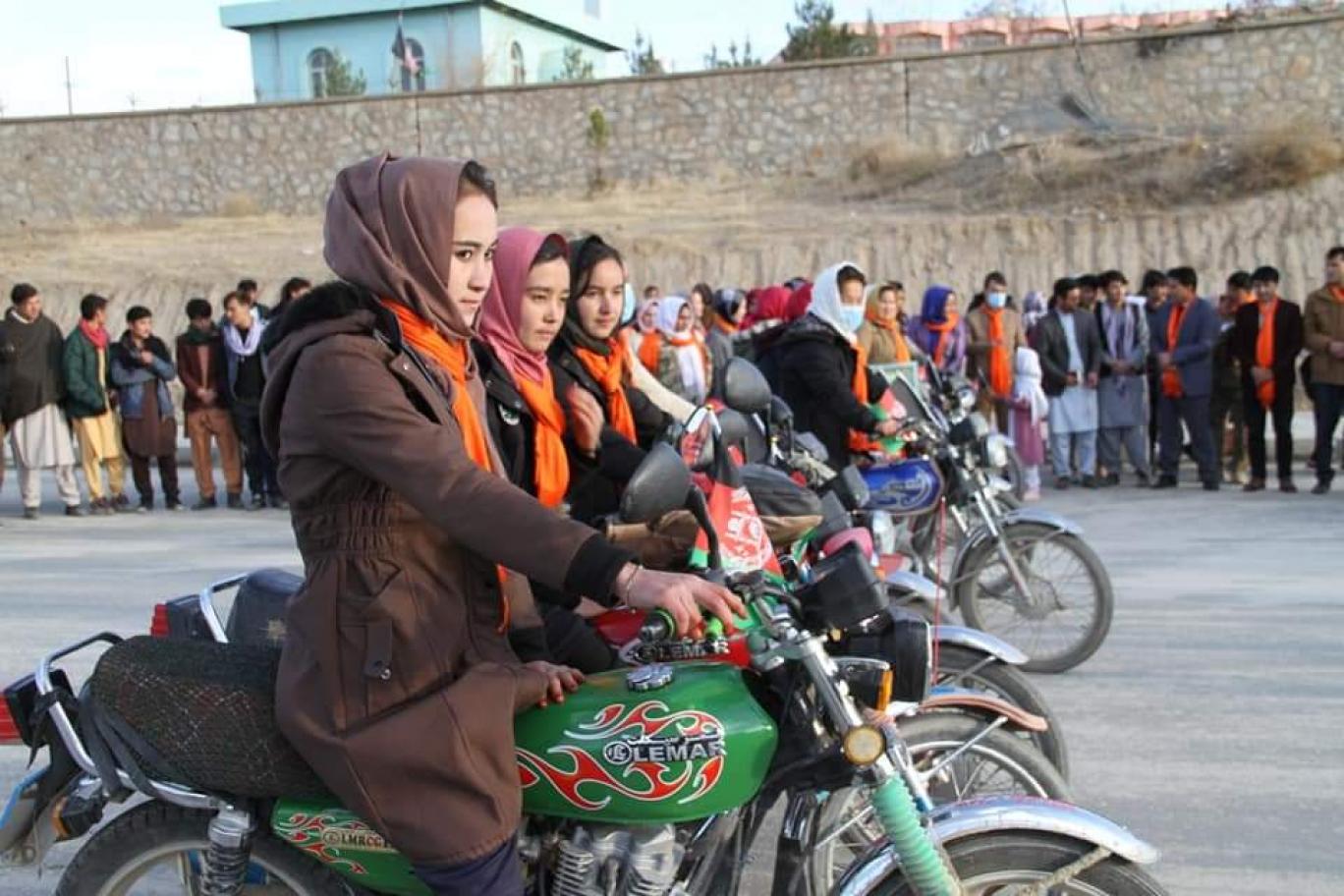
 Women motorcycle riders bring awareness
of women's rights in Afghanistan
Women motorcycle riders bring awareness
of women's rights in Afghanistan
In early December 2020, a 16-day campaign to raise
awareness about domestic violence came to an end in
Afghanistan, a campaign that included 10 young Afghan
women from the remote province of Daykundi, central
Afghanistan, riding motorcycles. The campaign was designed
to bring would bring people’s attention and support to the
issue of women’s rights in Afghanistan and was supported
by Oxfam International. (note: many campaigns against
domestic violence in Afghanistan are ongoing and new ones
are launched regularly).
It is rare for women in most Afghanistan to ride mopeds
or motorcycles except in the country’s mountainous areas
and very remote areas, where there are no proper roads and
the sight of a woman on a motorbike is, in fact, not
uncommon.
The women motorcyclists from Daykundi called on other
families to let their daughters learn how to ride bikes so
that their lives could be made easier.
Marzieh Hamdard, director of the Women’s Affairs Office
in the Daykundi province, told Independent Persian:
“This event was organised to show that riding a motorbike
is a normal activity, and that women have the right to go
about their day to day lives in an open, safe and better
environment”. Here is the story
in Persian and here
is the story in English.
With cameras & smart
phones, via motorcycles & tuk tuks, volunteers map
Dar es Salaam streets
Google Street View has not yet mapped the streets of many
large cities in developing countries, including Dar es
Salaam, Tanzania. These missing maps make it next to
impossible to track traffic congestion, to effectively
deploy resources to poverty-stricken communities and to
build public transportation systems. Maps of the city
detailing roads, homes, streams, drains and other features
could help by becoming the first step in adequate city
planning, including for disasters. A joint effort
involving volunteers and organized by the World Bank and
the Swedish start-up Mapillary aims to map the streets of
Dar es Salaam. "Sparking the community's interest in
mapping has the potential to truly transform Dar es Salaam
into a prosperous city with the infrastructure to prevent
floods, bring awareness to the need for flood prevention
and risk reduction, and arm its citizens with the right
tools and skills to build a better city," states a World Bank blog post celebrating the
mapping efforts. As they begin to come together, maps are
being run through InaSAFE, a free software that
reproduces natural disaster scenarios to help locals
improve city plans and disaster response efforts.
|
UNDP
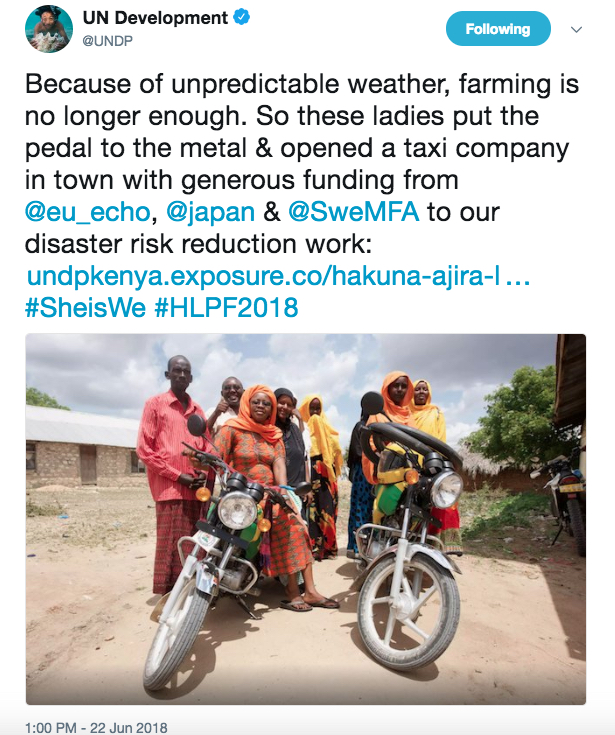
This June 2018 tweet (pictured at the left) by the
United Nations Development Programme (UNDP) notes
that, because of unpredictable weather, farming is
no longer enough for many people in Kenya, including
these ladies. As a result, these Kenya ladies "put
the pedal to the metal" and opened a motorcycle taxi
company in their town.
The project was supported with "generous" funding
from the European Union Commission, office of Civil
Protection and Humanitarian Aid, the
government of Japan, and the Swedish Ministry for
Foreign Affairs.
The photo is of "Bike Women group members" with
the two motorcycles they received through UNDP and
National Drought Management Authority (NDMA)
support
The original tweet was tagged with #SheisWe and
#HLPF2018
Here is an
article about this program overall (but the
photo and tweet are all I could find out about the
motorcycles, specifically).
|
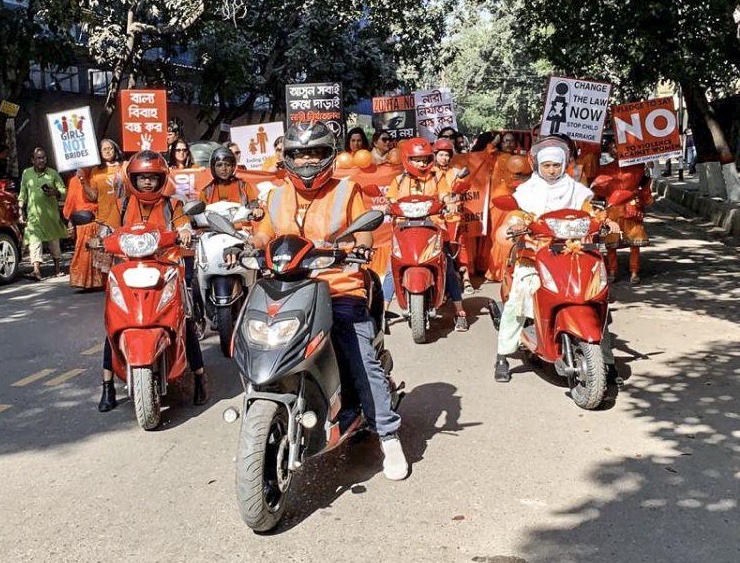 Women
on motorcycles in Bangladesh
Women
on motorcycles in Bangladesh
A 2017 study found that 80 to 90 percent of girls and
women in Bangladesh have been victims of sexual
harassment, verbal or physical, in public places. The
population of Bangladesh exploded from 100 million in 1990
to over 160 million in 2019, and more and more women are
looking for paid jobs outside the home. Just like women
everywhere, women in the Bangladeshi capital Dhaka want to
be able to walk on the streets and take public transport
without men bothering them, including to and from their
work places. Public transport, especially buses, can be
dangerous, as Roma Atiqua recounts: on one trip, a man
grabbed her breasts on a packed bus. She was furious and
knocked him off, but the other (male) passengers were on
his side. "You seduced him, he can't help it."
And so, women in Bangladesh,
as in some other countries, have
organized women-only taxis through the chaotic traffic,
including motorcycle and moped taxis women at the wheel.
That includes Atiqua, a 39-year-old businesswoman and
founder of Jabo Bohudur, a women's motorcycle training
facility. In 2018, the first motorcycle taxi service was
launched by and for women in Bangladesh: Lily Ride. Motor riding is not without a
struggle in this patriarchal society: early pioneers
were spit on and laughed at, pelted with stones, and
sometimes outright attacked.
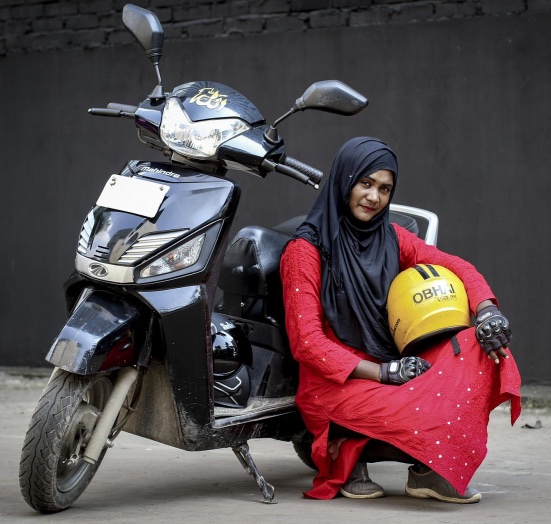
Now, a new organization, Obon, has been added, part of
parent company OBHAI and it trains women to become scooter
taxi drivers. More than 300 women now drive for them, some
with their own scooter, others with a company scooter.
Emergency GPS tracker included. Depending on the talent
and dedication of the drivers, the motorcycle riding and
taxi training takes one to three months. The women learn
to drive skillfully - the number one requirement in this
chaotic city - and also learn all emergency procedures,
basic engine mechanics and how to deal with difficult
customers. Women riders have participated in campaigns
against domestic violence, as is shown in the picture
above.
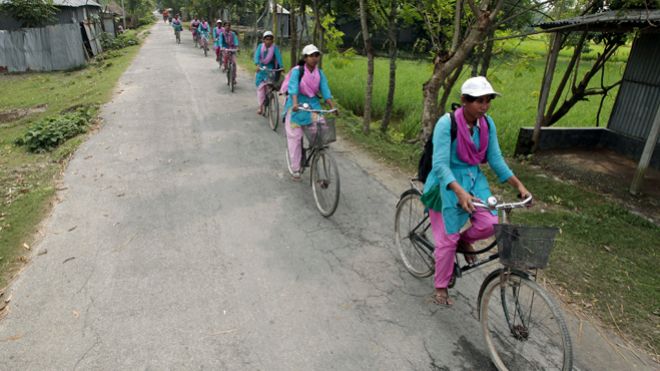
Bicycling
'Info Ladies' bring Internet to remote Bangladesh
villages
Also in Bangladeshi, dozens of Bangladeshi "Info Ladies"
ride bicycles into remote Bangladeshi villages with
laptops and Internet connections, helping tens of
thousands of people, especially women, get everything
from government services to chats with distant loved
ones. It's a vital service in a country where only 5
million of 152 million people have Internet access. The
Info Ladies project, created in 2008 by local
development group D.Net
and other community organizations, is modeled after a
program that helped make cellphones widespread in
Bangladesh. It intends to enlist thousands more workers
in the next few years with startup funds from the South
Asian country's central bank and expatriates working
around the world.
D.Net recruits the women
and trains them for three months to use a computer, the
Internet, a printer and a camera. It arranges bank loans
for the women to buy bicycles and equipment. Check out this
profile of a typical "Info Lady."
Motorcyclists
do good for Mandela's birthday
"A multiracial, multilingual group of South Africans have
ridden their motorbikes across the country's highways and
byways for the last week, doing good along the way." It
was July 2011, and it was part of the Bikers for Mandela
Day initiative -- their gift to Nelson Mandela for his
birthday. Supported by the U.N., Mandela's birthday is a
day of public service, on which people are encouraged to
spend at least 67 minutes doing some kind of community
service in honor of the 67 years Mandela spent fighting
for social justice. "In the small town of Harrismith the
bikers stopped off to paint a small orphanage, adding a
little color and a little hope to the children's lives..."
 Riders for Health
This is a nonprofit organization well know among adventure
motorcycllists world wide. The nonprofit uses motorcycles
and the training of local motorbike riders to improve
delivery systems for healthcare in Africa - specifically,
remote villages in The Gambia, Lesotho, Liberia, Malawi
and Nigeria.
"Run by nationals of the countries in which we work, we
employ more than 600 men and women, from apprentice
technicians to highly experienced country leaders. We
actively recruit and develop women in all roles and at all
levels."
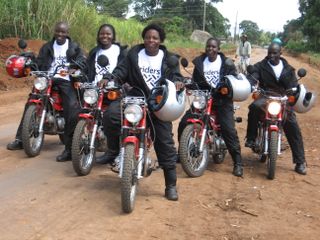
At left is a photo of African women
trained as health care workers and motorcycle riders by
Riders for Health. These health care workers provide
medicine and medical information to families in remote,
rural areas, navigating dirt and mud roads and pathways,
and crossing streams and rivers when necessary.
The nonprofit has a terrific
YouTube channel showing how they work. If you
watched the television show Long Way Down, you
saw Ewan McGregor and Charley Boorman visit a
Riders for Health site (and it's how I first learned about
the NGO and the role motorcycles can play in humanitarian
aid and development).
Motorcycles
helping to ensure access to maternal health services
in Zambia’s remote villages
The distance and lack of transportation from Mulala often
prevent pregnant women from reaching the health center,
particularly in instances of sudden onset of labor. FHI 360’s Zambia
Prevention, Care and Treatment Partnership (ZPCT II)
project is working in the Mansa District to ensure that
pregnant women have access to maternal health services.
ZPCT II, funded by the U.S. Agency for
International Development (USAID), has provided the
Mansa District with 12 motorcycle ambulances and three
traditional ambulances to help transport pregnant women to
local facilities where a trained birth attendant can
assist in their deliveries. These efforts are part of Saving
Mothers, Giving Life, a public–private partnership
that aims to dramatically reduce maternal mortality by
improving access to and quality of maternal health care.
Motorcycle
Outreach
A nonprofit introduces and supports effective healthcare
delivery - by motorcycle - in remote areas of developing
countries. Motorcycle Outreach works closely with the UK
Charity Riders for Health (RfH), which supports primary
health delivery in Nusa Tenggara Timur (NTT) in eastern
Indonesia. These two organizations provide motorcycles for
health workers, specifically midwives and nurses working
in public health centres that are responsible for large
areas but which have no means of transport to cover these
areas. Health care workers are trained on how to ride and
on basic maintenance, and the use of motorcycles is
monitored by Health for All and others such as community
leaders, the Ministry for Health in sub-district levels,
NGOs and the public. Motorcycle Outreach helps local
people to manage and control the road worthiness of the
motorcycle fleet, to ensure that a Zero Breakdown
principle is maintained. The health workers responsible
for the motorcycles fill in a logbook and the riders
themselves are regularly evaluated. Read
more about their activities.
Relief
Riders International
This organization has been running has run two or three
small group trips via horseback, where travelers tour an
exotic location and provide some simple humanitarian
relief to remote communities. They have recently added
trips via motorcycle. The service provided by riders is
more educational for the volunteers than critically
necessary for locals - you do not need to have any any
expertise, other than as a motorcycle rider, to
participate in these volunteer vacations.
Ted
Simon Foundation
A new foundation named for Ted Simon, a famous
international motorcycle traveler. It will "encourage and
assist travellers in making an extra effort to develop
their observations and insights into something of value
for the rest of the world to share, whatever their medium
of expression might be... We believe that individuals of
good will, moving among foreign cultures and making
themselves vulnerable to the beliefs and customs of
strangers, have great importance in promoting world
understanding, and even more so when they can distill the
essence of their experiences into a form that can be
absorbed by many."
Malcolm Smith Motorsports
Foundation helps children in Baja, Mexico
Baja, Mexico is a favorite
destination of adventure motorcycle riders from all over
the world. Established in 1998, Malcolm Smith
Motorsports Foundation says that it is a fully volunteer
organization that helps children in Baja. Facilities,
utilities and most costs are donated by Malcolm Smith
Motorsports, ensuring all dollars are used for the
children. The foundation has paid for a
fully-funded education for every child involved in its
program: tuition, books, uniforms, travel and room and
board where applicable. The foundation has also
paid for a facility, water systems for both potable and
agriculture water, electrical system for the site,
playgrounds and ball courts, a center for after school
studies and enrichment, beds, medical assistance in US for
extreme conditions, and a US-based summer internship
program for university age students.
Uganda’s boda boda babies: Indian-made motorcycle
taxis come to the rescue of pregnant women
Health services are uneven throughout Uganda. Some parts
of the country have village health teams deployed by the
government to help residents. In others, non-government
organisations or universities run projects that include
community health work. Since public transport is limited
and ambulance services are poor, boda bodas -
motorcycle taxis - are the preferred form of transport for
people both in Uganda’s cities and rural areas. Most of
the motorcycles that ply on Ugandan roads, including
Benic’s, are Indian imports. Though boda bodas are not the
safest form of travel, especially for pregnant women, they
are popular for their efficiency, easy availability and
low fares. As such, they have become an intrinsic part of
the country’s healthcare system. Used to ferrying pregnant
women, boda boda drivers like Benic have come up with a
few guidelines for how they conduct their service. They
make sure a relative accompanies the woman – which means
three people ride the motorcycle designed to carry two.
This is to ensure the mother-to-be, and the driver too,
have some help at hand in the all-too-possible event that
the baby comes before they reach the hospital. This
article by Priyanka Vora offers more; it's published
in Scroll.in, "an independent news, information, and
entertainment venture" focused on stories in or relating
to India.
The Gender Desk - Rwanda
The Gender Desk was launched in May 2005 at the Rwandan
National Police Headquarters under the framework of the
joint UNIFEM-UNDP Project, "Enhancing Protection from
Gender-based Violence." The Gender Desk includes an
interview room to enable women to speak in confidence with
a trained officer; a nationwide toll-free hotline service
for reporting gender-based violence; and a
UNIFEM-UNDP-funded adviser. UNIFEM facilitated quick
reporting and response to cases of violence and increased
awareness among the police and community of gender-based
violence as a human rights issue. Investigating officers
have been trained in victim empowerment, psychosocial
support and victim/survivor protection. Motorcycles,
provided by UNIFEM-UNDP, enable them to respond rapidly.
Members of the Global
Aids Interfaith Alliance, or GAIA, visited Blantyre,
Malawi in June 2003. "We spent time with the women who are
part of the GAIA program to strengthen women, thanks to a
grant from the Gates Foundation. Originally referred to as
women's empowerment, the program is now referred to in
terms of strengthening the family, as gender issues are a
strong force in this culture. Transportation is an
enormous issue for our local trainees. Their areas are
large, and flooding in the rainy season makes many
villages inaccessible and many roads impassable. One of
our decisions was to make small motorcycles available to
them. We also provided them with cell phones. Both have
been an enormous help as they go about their work." Read
the entire story
Motorcycles
and horses provide key ways to help rural people in
Lesotho, a tiny country landlocked within South
Africa about the size of Maryland. 25% of its adults are
HIV-positive. Pony riders to transport blood tests, drugs,
and supplies between remote mountain health clinics and
better-equipped hospitals at sea level. When roads are
navigable by two wheels, motorcycle
riders join the journey to further speed the process
of rushing blood to the lab or medication to those sick
with HIV. USAID and the Elizabeth Glaser Pediatric AIDS
Foundation support this effort.
eRanger:
Mobile Multimedia Classroom
The Digital Education Enhancement Project (DEEP) is a
research and development programme investigating the use
of information and communications technology (ICT) for
teaching and learning. It works in schools serving
disadvantaged communities in different parts of the world.
Partners: Open University, UK, Eastern Cape Department of
Education (ECDoE) & University of Fort Hare, Eastern
Cape. In April 2007, the DEEP team began testing a
prototype motorbike-based unit to transport ICT equipment,
support and training to a rural school in the Eastern
Cape, South Africa. Funders: Eastern Cape Department of
Education (ECDoE), The Open University Alumni & Ranger
Production Company. The aims of the prototype are:
- To provide sustainable access to ICT for remote,
rural schools;
- To explore the benefits in teaching and learning with
multimedia;
- To supply educational and ICT support onsite - the
eRider.
Two models of equipment are being tested, including a
'solo' unit for efficient on and off-road transport of
equipment for group work sessions, and a sidecar-based
education unit for larger school-based events. The
provision within the units comprise:
- On-board power, networking and internet connectivity
- Multimedia laptops for use in media-rich projects
- Digital Camera and Camcorder for recording footage
- Portable power generation for larger events
- Projection and amplifier equipment
During the prototyping phase, the eRider is an Education
Development Officer from the ECDoE, who is undertaking
this work as part of their role in developing eLearning in
the East London district of the Eastern Cape. The role of
the 'eRider' is:
- To provide support to the educators on how to use
multimedia to enhance teaching and learning
- To work with the learners in creating their own media
resources
- To supply educational and ICT advice
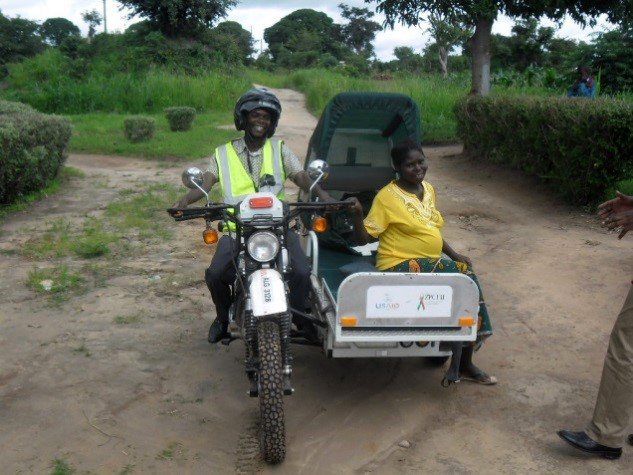 At left is a photo of motorcycle ambulance in
Zambia. The motorcycle has a side car to transport pregnant
women in rural areas, so they can reach health centers staffed
with trained birthing assistants. The rider also has some
medical training. This is a project by
At left is a photo of motorcycle ambulance in
Zambia. The motorcycle has a side car to transport pregnant
women in rural areas, so they can reach health centers staffed
with trained birthing assistants. The rider also has some
medical training. This is a project by