
Women's Access to Public Internet
Centers
in Transitional and Developing Countries
But many women and girls cannot or may not access public Internet points. Home and family obligations, lack of transportation, low-literacy and perceived lack of value of technology keep many women and girls from accessing public Internet access points. There's also another factor that is rarely talked about that keeps women and girls away from public Internet access points: in developing countries in particular, many of these public access points can be male-dominated, with mostly male users and few -- or no -- female users, and for many women, particularly women in developing countries, this makes the public access point off-limits to them. It's off-limits because
In Peru, public policy analysis in the ICT sector often excludes the important relationship between gender and technology. Hiperderecho’s research report — Are we connected? The digital gender gap in Peru — arises from the need to make visible how internet access is strongly influenced by socio-economic, non-technical factors such as gender, economic status and language.
The Digital Gender Gap Audit research for Peru was carried out by Hiperderecho, a Peruvian nonprofit organization that strongly believes that technology has the potential to be a tool for social inclusion and transformation for those who use it. In-depth interviews were carried out with government representatives, academia and activists in Peru to assess ICT policy measures on five themes:
The Digital Gender Gap Audit framework is part of the Women’s Rights Online initiative by the World Wide Web foundation. The research assesses government actions to achieve the Sustainable Development Goals on women and technology and highlights the steps needed to close digital gender divide. Women’s Rights Online Digital Gender Gap Audit research has been carried out in eighteen countries across Africa, Asia and Latin America.
Women farmers in a rural area of Peru were reluctant to use computers and the internet from a nearby telecenter because they thought they were just for children, no one had told them how they could use them to help their farming be more successful and because there are security issues for women to use public transport to get to the centers. The Association for Progressive Communication has found that women over the age of 35 are often times considered “too old” by younger people and men to use ICTs and learn about computer technology.
D.Net (Development Research Network), a non-profit organization that focuses on technology for economic development in Bangladesh, found that cultural factors in Bangladesh played a bigger role in whether or not a girl attended computer literacy classes than lack of money or resources. Girls were often denied the chance to participate in computer training because it is considered socially inappropriate in Bangladesh, in part because the classes were held after school when it was dark out, but also due to entrenched community attitudes that encourage computer and internet use among boys but not girls. D.Net was able to build better opportunities for girls to access the classes through direct consultation with mothers, female teachers, and the girls themselves).
In Afghanistan, women and girls are denied Internet access for a variety of cultural reasons. It means even educated women and girls from economically-stable families may be denied by access to the Internet for professional development, educational needs and health care information. Even if she has Internet access at home, she may have to wait until all of the men of the home are done with such - and is denied opportunities community Internet centers can bring (classes, mentoring and learning from peers). I mentor Afghan women in Kabul via the Internet, and I hear about these circumstances first hand, and I saw it first hand when I was in Kabul for six months in 2007).Back in August 2003, I had the pleasure of co-hosting an online discussion at TechSoup regarding Gender and the Digital Divide with Latifat Kadir, who lives in Lagos, Nigeria - we hosted the online discussion as online volunteers (virtual volunteering!). The event included a discussion regarding the barriers that keep women and girls away from computer and Internet-related classes and community technology centers (telecenters, Internet cafes, etc.). Latifat and other women shared their stories of cultural barriers that kept them from using public Internet access points. It's interesting to note that, in the years since the original discussion a few men have posted to deny there are any barriers to women using the Internet, including in developing and transitional countries. Obviously, much more education is needed.
Developing/transitional countries need women-only public Internet access points. Or at least women-only hours at such points. Women-only centers -- or centers that have women-only hours -- would need to provide:
I wish I had been in a position to make such a program happen myself in Kabul when I was there.
I'll keep collecting information that might be helpful to a person or organization interested in undertaking such venture, in Afghanistan or elsewhere. Here's what information I gathered (if a URL no longer works, please look for the URL in archive.org):
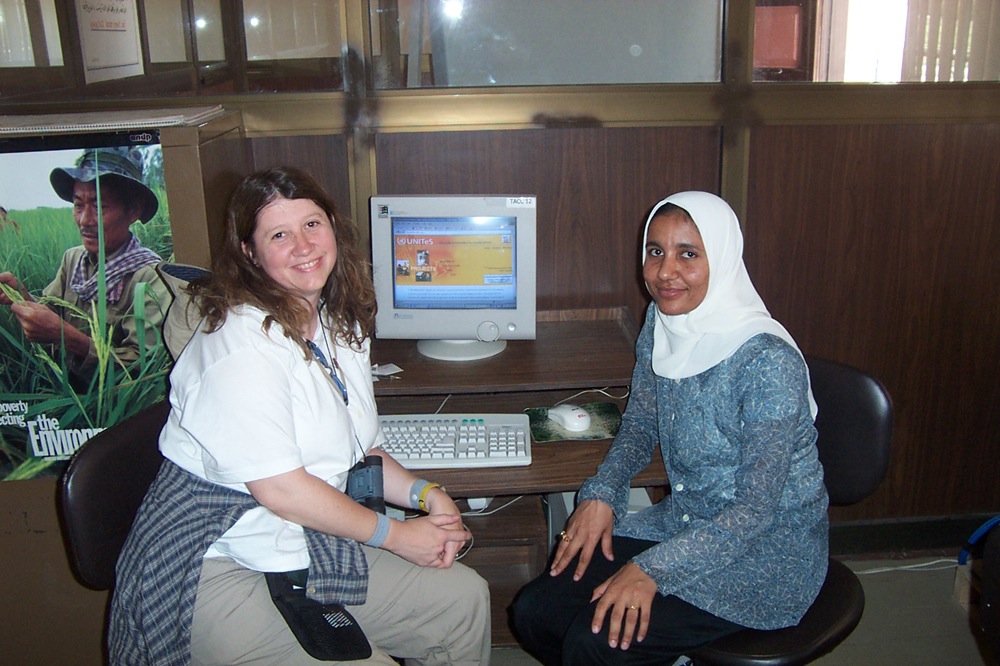 |
This is me at the UNDP
Community Technology Center (CTC) in Luxor, Egypt,
with the center's manager in April 2003. I
was on vacation, but that never stops me from
dropping in on UNDP projects I find whilst on
vacation. It was great to show her my UNDP business
card and to see her face light up - I was immediately
welcomed like an old friend!
This is (was?) not a women-only center, and the manager was usually the only woman in the center; few women used the center. The day I visited, she was just closing for the day, and I walked around with her to shut the computers down after the patrons had left. Sad to say that the men leaving the center had left most of the computers on web pages with women in various stages of undress. It was my moment-of-realization about what women face in trying to use public Internet access points in many countries. |
Thanks to the students in DTC 475 Digital Diversity, taught by Kathi Rick, at Washington State University Vancouver, for being the first to read this web page!
This page was inspired by an online event/conversation on the TechSoup Community Forum in 2003, which I co-hosted with Latifat Kadir of Lagos, Nigeria. At the time, I was based in Bonn, Germany, working for the United Nations.
Read more about my own women-focused/gender-inclusive work.
Empowering Women Everywhere - Essential to Development Success, a list of research and articles that confirm that empowering women is essential to development success and highlight the very particular challenges to women's access to education, health care, safety and economic prosperity.
Also see:
cyber cafés cybercafés cybercafes cyber cafes
 my home page my consulting services
& my workshops &
presentations my credentials & expertise Affirmation that this web site is
created & managed by a human. My book: The Last Virtual
Volunteering
Guidebook contact me or see my schedule Free Resources: Community Outreach, With & Without
Tech
my home page my consulting services
& my workshops &
presentations my credentials & expertise Affirmation that this web site is
created & managed by a human. My book: The Last Virtual
Volunteering
Guidebook contact me or see my schedule Free Resources: Community Outreach, With & Without
Tech Free Resources:
Engaging & Supporting
Volunteers Free Resources: Technology Tips for Non-Techies Free Resources: Nonprofit, NGO & other
mission-based management resources Free Resources: Web Development, Maintenance,
Marketing for non-Web designers Free Resources: Corporate philanthropy / social
responsibility programs Free Resources: For people & groups that want
to volunteer linking to or from my web site The Coyote Helps Foundation me on social media
(follow
me, like me, put me in a circle, subscribe to my newsletter)
Free Resources:
Engaging & Supporting
Volunteers Free Resources: Technology Tips for Non-Techies Free Resources: Nonprofit, NGO & other
mission-based management resources Free Resources: Web Development, Maintenance,
Marketing for non-Web designers Free Resources: Corporate philanthropy / social
responsibility programs Free Resources: For people & groups that want
to volunteer linking to or from my web site The Coyote Helps Foundation me on social media
(follow
me, like me, put me in a circle, subscribe to my newsletter) how to support my work
To know when I have developed a new
resource related to the above subjects, found a great
resource by someone else, published
a
new
blog, uploaded a new
video,
or to when & where I'm training or presenting, use any
of the following social media apps to follow me on any of
these social media platforms:






Disclaimer: No guarantee of accuracy or suitability is made
by
the poster/distributor of the materials on this web site.
This material is provided as is, with no expressed or implied
warranty or liability.
See my web site's privacy policy.
Permission is granted to copy, present and/or distribute a limited amount of material from my web site without charge if the information is kept intact and without alteration, and is credited to:

Otherwise, please contact me for permission to reprint, present or distribute these materials (for instance, in a class or book or online event for which you intend to charge).
The art work and material on this site was created and is copyrighted 1996-2026