Originally posted in 2008 - it
has been slightly updated since then

A free resource for nonprofit
organizations, NGOs, civil society organizations,
charities, schools, public sector agencies & other
mission-based agencies
by Jayne Cravens
via coyotecommunications.com
& coyoteboard.com
(same web site)
Being an Online Mentor: A Real
Relationship, A Real Commitment
(What I've Learned as an Online Mentor)
One of the most sought-after online volunteering activities is
mentoring another person via the Internet. But while many, many
people may desire to make a difference in someone's life by
working with that person online, many of these same people also
often have a misconception that mentoring online takes far less
time and commitment than traditional, onsite volunteering - that
it takes just minutes, even seconds, every now and again, rather
than an ongoing investment of several hours (yet another myth of online volunteering).
Mentoring someone online takes real time and commitment, because
mentoring requires trust-building. Relationships have to be
cultivated, personalities and points of view have to understood,
and respect has to be earned - and none of that happens in just a
few seconds or a few minutes when you might have some time to
spare. The work required for online mentoring doesn't happen only
at the most convenient time for the volunteer; the mentor has to
schedule real time for mentoring to happen regularly, and for
questions and comments by the person being mentored to be
addressed promptly and fully. A mentoring relationship can
actually cause harm to the person to be mentored if the volunteer
does not make the relationship a priority, and makes the person to
be mentored feel forgotten or not of great importance.
I have been an online mentor several times, including:
- one-on-one exchanges with a fourth grade girl in Austin
Texas, part of the Sanchez
Elementary School Online Mentoring Program, to help build
students writing abilities and to reinforce good practices in
online safety (2000)
- one-to-many exchanges for the Young Caucasus
Women Project, recruited from adult students from Armenia,
Azerbaijan and Georgia in the US State Department's Future
Leaders Exchange (FLEX) Program, to help them as part of their
training as citizen journalists (2006)
- one-on-one exchanges with students interested in careers in
international development work, through Open University, where I completed my Master's Degree
(2004 - 2007)
- one-to-many exchanges for new women bloggers in Kenya,
through Fahamu and the Women's Technology
Empowerment Centre (W.TEC), to help them learn to use
blogs as a method of democratic expression and empowerment
(2008)
- one-to-many exchanges for the inaugural Blogs for
African Women (BAWo) Mentoring Project, focused on women
living in Nigeria, to help them learn to use blogs as a method
of democratic expression and empowerment (2008)
- one-on-one exchanges with a graduate student and former
co-worker in Kabul, a young Afghan woman undertaking her final
project for her Master's Degree, researching the importance of
women leaders to development success (2007-2009); then again
when this same former co-worker was studying for a second
Master's Degree in Brisbane, Australia (2011-2013).
How did I become involved in these online mentoring experiences?
- I sat up the Sanchez
Elementary School Online Mentoring Program myself, and
wanted to experience the program as a mentor as well.
- I read about the three women bloggers projects on one of the various online communities with
which I'm involved, and contacted each to become involved.
- I responded to a request for volunteers from Open University
in their student or alumni magazine (I forget which).
- I set up the latest experience mentoring the graduate student
in Afghanistan myself, before I left the country after working
there for six months in 2007.
The most satisfying relationships for me have been the
one-on-one exchanges, where I am working with and focused on just
one person. In such online relationships, I feel like I'm not only
making a real difference, but also building a very real
relationship. The one-to-many exchanges are worthwhile - I do
think I've passed on some good information, as well as learning a
lot myself - but it's the one-on-one relationships that have been
most satisfying for me, personally, and that I feel that I see
real results because of the online exchanges.
Not every online mentoring relationship has been successful. In
one program, xxxx, those to be mentored seemed unclear about what
the purpose of the program was for, and their messages to our
private communications platform didn't seem to have any particular
focus - I can't tell you much of anything about the students I was
trying to help. In the Sanchez program, the mentoring
relationships ended when the program ended and the private
communications platform was discontinued, much to the
disappointment and even sadness of the students involved; for
them, their mentors "disappeared."
For all of these online mentoring experiences, what has been
most important for me to be successful as a volunteer mentor are:
- to know this is going to be a well-run program, affiliated
with a credible organization, with a contact person to help me
promptly with technical issues and any issues I may have as a
part of my mentoring, and with clear, well-stated, realistic
program goals that are a part of an overall onsite
activity or program (and in the case where I am engaged in
one-on-one mentoring with my former colleague from Afghanistan,
I wrote out a list of expectations for us both, and we set goals
for every semester for us both regarding communications).
- to have the program goals always in mind during all
exchanges. I often re-read them just before I write, so I can
make sure I'm focused on such in all communications with the
person or group I'm mentoring.
- to set a time every day, every other day, or twice a week --
as appropriate -- to read messages from the person to be
mentored or those to be mentored, and to craft an appropriate
response. If I'm helping with a specific project or assignment,
such almost always has a deadline, and I have to be able to put
in the time needed to offer appropriate guidance, proofread an
assignment, etc., long before the deadline, so that the student
has time to read what I've said, process it and turn in the
assignment. In other words, online mentoring is not
for whenever I have some time; it's a real commitment, and
it means rearranging things in my onsite life to meet that
commitment.
- to find out as much as possible about who the people to be
mentored are, where they come from, what their daily life is
like, what languages they speak, how comfortable they are in
writing, what they expect of the program and the exchanges with
the mentors, and what they know, and don't know, about the
mentors.
- that people who are not native English speakers, are very
young, or are part of a culture where women are not supposed to
be talkative or have public opinions, are often quite
self-conscious about expressing themselves in writing, and I
need to be able to craft questions and comments that are easy to
understand and don't sound overtly critical or possibly
demeaning.
- to appreciate that those to be mentored may come from areas
with very different values, very different standards of living
and very different beliefs than the mentors.
- to appreciate that those to be mentored are not as tech-savvy
as me, and therefore, I need to avoid tech jargon and I need to
fully, simply explain how to use certain tech tools, such as how
to use Google to find
resources for a project.
- to encourage students to do things themselves, rather than
having me do such for them; the goal is always to build a
student's capacity in some way.
- to maintain a very positive, upbeat approach in written
communications, and to write frequently, so that students feel
warmly supported by me.
- to keep writing those to be mentored even if they aren't
responding to my messages every time.
- to be careful not to write something that sounds overly
critical or could be interpreted as even slightly insulting.
Criticism is fine, but it must be surrounded by a lot of sincere
praise.
- that misunderstandings are bound to happen; I work to avoid
them, but when they happen, I work to mend hurt feelings.
Regarding my experiences mentoring my Afghan colleague,
specifically:
- We use a YahooGroup of our own to communicate. I have the
settings on private, so that only the two of us can see the
group, let alone access what's inside of it. All messages sent
to the YahooGroup also go into our personal email boxes, so we
know when something has been added. We use it for messages, to
store drafts of her work and my edits of such, and for me to
share links to web resources I believe can help her in her
research.
- I know her, personally - we've met onsite, face-to-face. We
haven't seen each other in-person since 2007, but working
together for several months in a traditional setting makes a big
difference in our working together well now online. Not that
online mentoring relationships can't work without meeting "in
the flesh", but having had this previous real-time, onsite
relationship helped us to be able to work well together online
immediately.
- I have studied the same thing she is studying: community
development, and managing such projects and programs. I also
have experience in helping projects to be more welcoming and
inclusive of women, an are of special focus she would also like
to have.
To date, all of my online mentoring experiences have been via
written communications and have been asynchronous rather than
synchronous; mentors, and those to be mentored, don't have to be
online at the same time. This is all done usually via a special
password-protected online platform, so that exchanges are private
and can be easily monitored. Sometimes, this platform hides the
identities of the mentors and those to be mentored; we know each
other only through "handles" or user name; the reason for such a
system, is for online safety -- messages are monitored so that there
is no way for participants to contact each other outside the
program's communications platform.
Would video work in online mentoring? Certainly, provided that
all participants:
- are very comfortable using such tools entirely on their own,
without needing training beyond guidance that could be written
in an email
- have reliable broadband Internet connections and very modern
computers
- are in similar time zones
- feel comfortable speaking, at least initially, with a
"stranger"
- feel comfortable speaking with someone who is significantly
older, or who may speak better English than they do themselves
- have a space with little or no noise around them and few
distractions where they may engage in such live video
interactions
- have clear guidance regarding the purpose of each live video
interaction
If you want detailed information on how to work with online
volunteers, and how to fully integrate virtual volunteering in to
all of your community engagement, including how to set up and
support an online mentoring program, see:
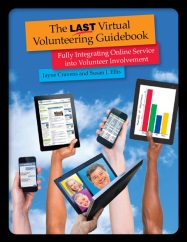 The Last Virtual Volunteering Guidebook
available
for purchase as a paperback & an ebook
Completely revised and updated, &
includes lots more advice about microvolunteering!
Published January 2014.
Also see:
Discuss
this
web page, or comment on it, here.
Quick Links
 my home page
my consulting services
& my workshops &
presentations
my credentials & expertise
Affirmation that this web site is
created & managed by a human.
My book: The Last Virtual Volunteering
Guidebook
contact me or see my schedule
Free Resources: Community Outreach, With & Without
Tech
Free Resources: Engaging & Supporting
Volunteers
Free Resources: Technology Tips for Non-Techies
Free Resources: Nonprofit, NGO & other
mission-based management resources
Free Resources: Web Development, Maintenance,
Marketing for non-Web designers
Free Resources: Corporate philanthropy / social
responsibility programs
Free Resources: For people & groups that want
to volunteer
linking to or from my web site
The Coyote Helps Foundation
me on social media (follow
me, like me, put me in a circle, subscribe to my newsletter)
 how to support my work
To know when I have developed a new
resource related to the above subjects, found a great
resource by someone else, published
a
new blog, uploaded a new
video,
or to when & where I'm training or presenting, use any
of the following social media apps to follow me on any of
these social media platforms:






Disclaimer: No guarantee of accuracy or
suitability is made by the poster/distributor of the materials
on this web site.
The information provided on this website is for general
informational purposes only and should not be considered legal
advice.
I am not a lawyer. I am not a legal professional. Do any
information on this site as legal counsel.
I am not responsible for any losses, damages, or liabilities
that may result from the use of this website or reliance on its
content.
Your use of this website and its information is at your own
discretion and risk.
This material is provided as is, with no expressed or implied
warranty or liability.
See my web site's privacy
policy.
Permission is granted to copy, present and/or distribute a limited
amount of material from my web site without charge if
the information is kept intact and without alteration, and is
credited to:

Otherwise, please contact me
for permission to reprint, present or distribute these materials
(for instance, in a class or book or online event for which you
intend to charge).
The art work and material on
this site was created and is copyrighted 1996-2026
by Jayne Cravens, all rights reserved
(unless noted otherwise, or the art comes from a link to
another web site).