
Donating Things Instead of Cash or Time
credits and disclaimer and Why should you trust the information on this web page?
It's a wonderful thing to donate cash or to donate time (volunteer) for nonprofit organizations, NGOs, charities, etc. And it can be a wonderful thing to donate things - food, furniture, clothes - to help others.
NOT saying that in-kind donations to charities are always wrong. In-kind donations are NOT at all always wrong. Donating to Goodwill means you help raise funds for their job training programs. Donating to Habitat for Humanity ReStores means you help fund home building, homeowner education for under-served populations, neighborhood clean ups and more.
And, yes, there are some nonprofits that can make use of in-kind donations not to sell, but to donate to others in need. One of my favorite is Community Warehouse in Oregon, which does a masterful job of both managing donations (and they are very picky) and partnering with nonprofits to get clients (you can't just walk in without a referral) - reduces waste, helps keep warehouse inventory manageable and better ensures equity. This nonprofits Facebook pageis one of my favorites as an example of excellent community outreach and awareness-building. Many refugee agencies right in your own community are probably looking for furniture donations, but they are often looking for specific items, ones they can pick up and immediately deliver to a family that is moving into an apartment - they usually have zero storage space for such items.
So, yes, hurrah, in-kind donations.
But to those who say that in-kind donations are better than cash donations for nonprofits and that this is a "trend" that needs to be expanded, here are some articles that say otherwise (and I know so many nonprofit folks are nodding in agreement - in-kind donations don't pay staff, don't pay utility bills, don't pay for the copier rental, and on and on).
If you are going to donate anything, it should be clean and
ready-to-use. It should not be torn, stained or broken. It should
not be missing any parts. If it's electronics, you should plug it
in first and make sure it works. If it's been in a storage box for
a while, you need to take it out of that box and make sure it
hasn't been spoiled by water, mold, moths or vermin.
If it's torn, broken, stained, needs to be repaired, etc., find a
place to recycle it or throw it away responsibly - do NOT try to
donate it unless you have found a place that has seen it in person
or a picture of it and has said, "Oh, yes, we want that."
Whatever you donate should be something an organization - not a
person at work or at your community of faith, but an organization
- has said, in writing, on their web site, or in a news story that
you saw yourself, that they need. And you should follow their
directions exactly on how to donate: respect their hours of
business, don't leave items stacked outside a gate after hours,
etc.
One of the best places to donate new or clean used clothes,
clean used toys, clean dishes and cookware, electronics
(VCRs, TVs, stereos, CD players, computers) and clean used
furniture is Goodwill,
which uses its store both to train people who are entering or
re-entering the workforce and to raise money for its programs. By
giving to Goodwill, you are helping to train people who want
to work but need training and experience in order to get a job,
you are helping the organization raise money for their programs,
and you are better ensuring your items will get to someone who
really wants them. Note the emphasis on clean items -
please do NOT donate dirty, soiled or worn clothes, nor broken
electronics, nor broken anything, to Goodwill.
Another great place to donate furniture and housewares is
a Habitat for Humanity ReStore. These items are sold to fund the
work of Habitat for Humanity in your area, to help families become
homeowners and to help vulnerable homeowners, such as people with
disabilities, with repairs that can help them stay in their homes.
Please do not donate anything dirty, soiled, broken or missing
parts to a ReStore. Please donate things that are showroom ready.
Habitat also takes vehicle donations: cars, trucks,
motorcycles, boats, and more (and the vehicle does NOT have to be
running - as long as you have the title, they will probably take
it).
Used, clean, completely-stain-free business clothes for
women would be welcomed at a woman's career closet, if there
is such in your area. Call your local YWCA, United Way and
Goodwill to find a career closet for women in in your area (again,
note that your area may not have such).
For really special items, such as items that are vintage, or
that represent a particular era, contact your local
community theater, the theater department at the nearest college
or university, or even your local historical society.
For musical instruments, contact the music faculty at the
local high school and local colleges and universities. Note that
pianos are EXTREMELY hard to donate. It is easy to find someone
getting rid of a piano in great condition - it's much harder to
find someone willing to pay to have it delivered to someone who
wants it.
Any search engine can help you find nonprofits in your area where
you can donate usable electronics (cell phones, MP3
players, TVs), clean, ready-to-use furniture, clean, ready-to-wear
clothes, books, unopened food containers,
including pet food, fresh produce, office
supplies and more. Every community is different in terms of
what nonprofits it has that can accept such items.
There may be a bicycle recycling intiative in your area.
Find out by typing in the name of your city and state, and the
phrase bicycle donation, then again with the phrase bicycle
recycle into a search engine.
You can donate a used brace, crutches or a prosthetic to PIPO Missions, which refurbishes donated items and then custom-fits and delivers them to people in need in rural Mexico.
Donate used eye glasses to Lions
Club International. Volunteers at Lions Eyeglass Recycling
Centers (LERCs) clean, sort by prescription strength and package
the glasses. Most of the recycled glasses are distributed to
people in need in developing countries where they will have the
greatest impact.
Clean, usable, not-broken camping equipment (tents,
sleeping bad, cooking equipment, lanterns), can go to your local
Goodwill, your local Habitat ReStore, or any charity thrift shop
that sells stuff. There's also Adventure 16's Donate-A-Pack
Foundation, which exists to benefit at-risk, low income, or
disabled youth in Southern California by enabling them to partake
in an outdoor wilderness experience. The foundation accepts all
types of outdoor gear in usable condition, in addition to
backpacks. The most needed items are sleeping bags, pads, tents
and backpacks, but we also accept cook sets, stoves, water
filters, footwear, apparel and more. Unless an item is badly
damaged or falling apart, you can bring the item to one of the Adventure 16
stores in Southern California (they also accept shipped
items - see the
web site for details.
You can donate bone marrow as part of the Be the Match national
registry.
You can donate blood to your local American Red Cross blood bank. Note that donate means you are NOT paid.
You can designate now that your organs and tissue be donated after your death to people in need. OrganDonor.gov has complete information.
You can designate now that your entire body be donated
after your death to people in need. MedCure is a nonprofit that
accepts these donations.
I used to list nonprofits that said they would ship items
overseas to military service members and their families, or to
people in need in other countries, as well as organizations that
accepted homemade blankets and other home-made sewn or knitted
items, but I stopped because so many of these nonprofits don't
exist anymore. These organizations seem to come and go so quickly,
I can't keep up. So, again, use a search engine to find such
organizations.
If you have a meeting room at your company or
organization, you could allow a nonprofit in your area to book the
room once a month for their board meetings or member meetings,
depending on how many people the room can fit. For instance, Girl
Scouts has troop leader meetings once-a-month for adult
volunteers. Lots of nonprofits need a space to have a board
meeting or a volunteer training once-a-month.
You can advocate for any of the aforementioned organizations, or any organization you want to support, using your own online networks. Read more on how you can advocate for an issue important to you.
And, of course, you can VOLUNTEER.
Your time, energy and expertise are SO NEEDED. Volunteering will
increase your connection to a cause and those working to promote
that cause, as well as help build your understanding of issues
related to that cause.
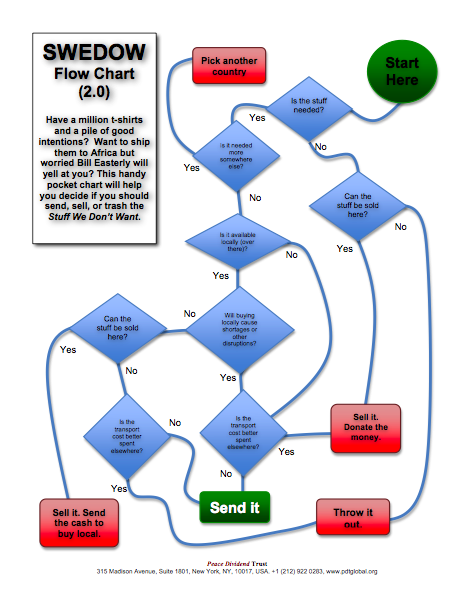
Also see this SWEDOW chart (download it for the full size):
Also see
How to Make a Difference Internationally/Globally/in Another Country Without Going Abroad
Detailed information on Finding Community Service and Volunteering for Teens.
How to Find Volunteering Opportunities, a resource for adults who want to volunteer
Advice for volunteering as a group / volunteering in a group
Volunteering In Pursuit of a Medical, Veterinary or Social Work degree / career
Advice for family volunteering - volunteering by families with children and, related, advice for teaching children compassion & understanding instead of pity with regard to poverty.
Advice for Finding Volunteer Activities During the Holidays
Online Volunteering (Virtual Volunteering)
Fund Raising For a Cause or Organization
Crowdfunding for a Personal Cause: A Sick Family Member, Someone in Dire Financial Crisis, Etc.
Using Your Business Skills for Good - Volunteering Your Business Management Skills, to help people starting or running small businesses / micro enterprises, to help people building businesses in high-poverty areas, and to help people entering or re-entering the work force.
Creating or Holding a Successful Community Event or Fund Raising Event.
Group Volunteering for Atheist and Secular Volunteers
If you are seeking volunteering in order to fulfill a community service obligation from a court or school obligation, see this resource.
How to complain about your volunteering experience.
Careers Working With Animals (for the benefit of animals)
Volunteering To Help After Major Disasters.
Ideas for Funding Your Volunteering Abroad Trip.
How to Get a Job with the United Nations or Other International Humanitarian or Development Organization
Ideas for Leadership
Volunteering Activities
These are more than just do-it-yourself volunteering - these are
ideas to create or lead a sustainable, lasting benefit to a
community, recruiting others to help and to have a leadership
role as a volunteer. These can also be activities for the Girl
Scouts Gold Award, the Duke of Edinburgh's Award (U.K.), a
mitzvah project, or even scholarship consideration.
Ideas for Creating Your Own Volunteering Activity.
Helping People Address Their Problems
with Plastic
How to mobilize a community to clean up plastic bottles, plastic
bags and other plastic waste from their environment, and how to
reduce their use of such items in the future
 my home page my consulting services
& my workshops &
presentations my credentials & expertise Affirmation that this web site is
created & managed by a human. My book: The Last Virtual Volunteering
Guidebook Free Resources: Community Outreach, With & Without
Tech Free Resources: Technology Tips for Non-Techies Free Resources: Nonprofit, NGO & other
mission-based management resources Free Resources: Web Development, Maintenance,
Marketing for non-Web designers Free Resources: Corporate philanthropy / social
responsibility programs Free Resources: For people & groups that want
to volunteer linking to or from my web site The Coyote Helps Foundation me on social media (follow
me, like me, put me in a circle, subscribe to my newsletter)
my home page my consulting services
& my workshops &
presentations my credentials & expertise Affirmation that this web site is
created & managed by a human. My book: The Last Virtual Volunteering
Guidebook Free Resources: Community Outreach, With & Without
Tech Free Resources: Technology Tips for Non-Techies Free Resources: Nonprofit, NGO & other
mission-based management resources Free Resources: Web Development, Maintenance,
Marketing for non-Web designers Free Resources: Corporate philanthropy / social
responsibility programs Free Resources: For people & groups that want
to volunteer linking to or from my web site The Coyote Helps Foundation me on social media (follow
me, like me, put me in a circle, subscribe to my newsletter) how to support my work
Disclaimer: No guarantee of accuracy or
suitability is made by the poster/distributor of the materials
on this web site.
The information provided on this website is for general
informational purposes only and should not be considered legal
advice.
I am not a lawyer. I am not a legal professional. Do any
inforamation on this site as legal counsel.
I am not responsible for any losses, damages, or liabilities
that may result from the use of this website or reliance on its
content.
Your use of this website and its information is at your own
discretion and risk.
This material is provided as is, with no expressed or implied
warranty or liability.
See my web site's privacy policy.
Permission is granted to copy, present and/or distribute a limited amount of material from my web site without charge if the information is kept intact and without alteration, and is credited to:

Otherwise, please contact me for permission to reprint, present or distribute these materials (for instance, in a class or book or online event for which you intend to charge).
The art work and material on this site was created and is copyrighted 1996-2026